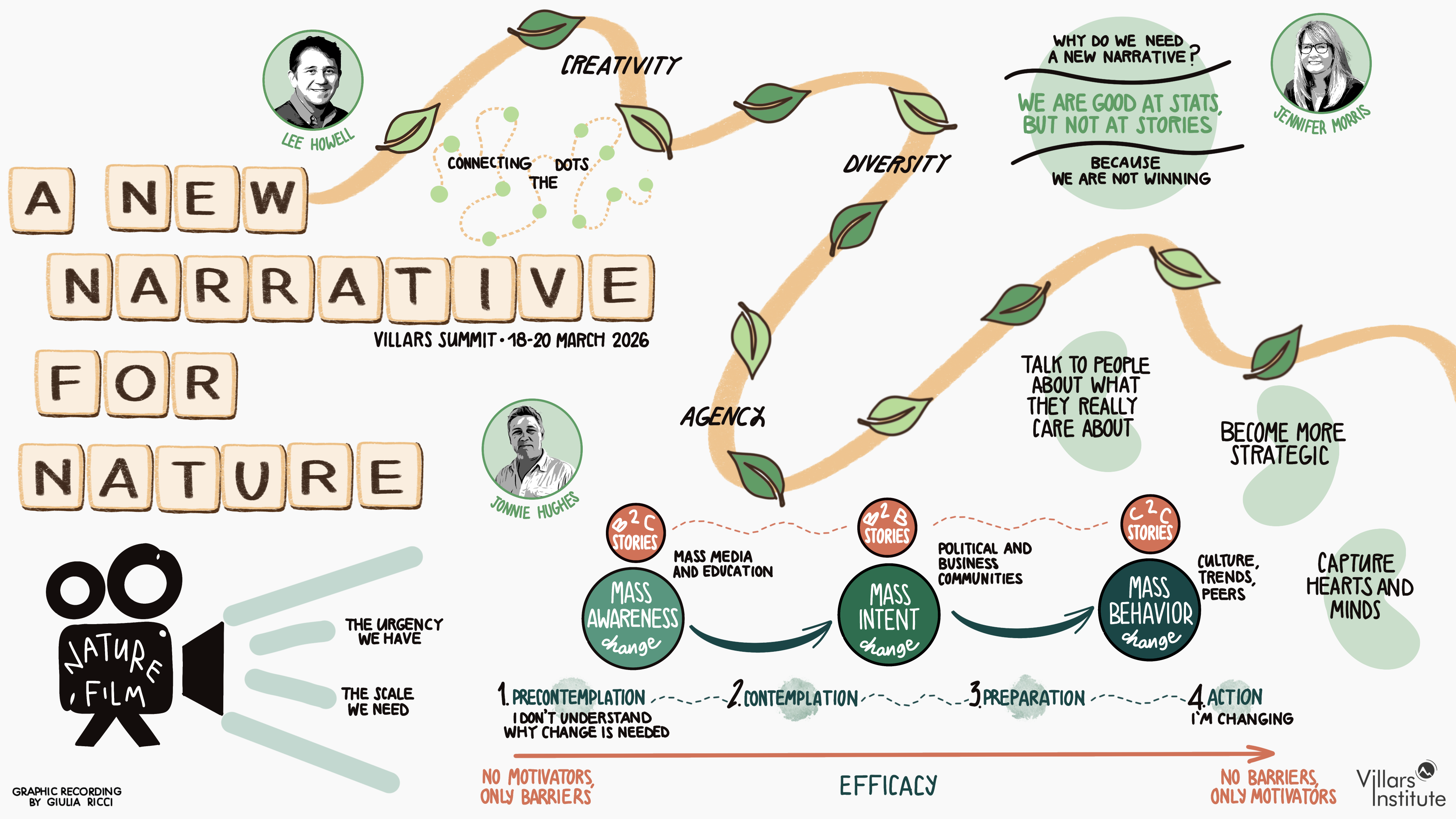


If we want the climate movement to start having a real impact, we need to face the reality that we are not winning. We are good at statistics but not at stories. We are numbing the public with numbers, a public who, in order to be spurred to action, needs connections to places and people that resonate with them. To make these connections and start turning awareness into intent and finally into behaviour, we need a new narrative for nature. In this plenary session, attendees learnt how we, as changemakers from many diverse backgrounds and areas of expertise, can begin to connect the dots and create meaningful narratives for action. This session covered two primary questions: “Why do we need a new narrative for nature?” and “How can we achieve it?”, across two key audiences: the general public, whose convictions are the ultimate catalyst for change, and the decision-makers who must choose how to action the change that the public calls for.
Statistics and progress reports have their place in the offices of policymakers: they are undeniably powerful tools to help politicians, economists and business leaders. However, the fact remains that most true action is galvanised by the hearts and minds of the people – decision-makers must act according to their feelings. Thus, we cannot overlook the overwhelming extent to which action is shaped by the prevailing narratives in our societies. In the eyes of the public, endless numbers and reports that track climate disasters serve only to create apathy and anxiety. Likewise, creating a new narrative around health – arguing that our livelihoods, wellbeing and survival are critically threatened by climate change – can only motivate people and decision-makers if the threat is perceived as imminent and urgent. We must realise that, in the current political climate, priority is given to preserving jobs, economic livelihoods and national security. These are therefore the stories we must share to spark motivation and action in both the public and decision-makers. One example is outdoor recreation – in the US in 2023, outdoor recreation generated $1.2 trillion in economic output (2.3% of the country’s GDP), comprising 3.1% of US employees. The jobs and livelihoods of the five million people employed by the outdoor recreation industry are all threatened by climate change. It is stories like this that need to be shared with decision-makers, so that they can take action based not just on morals, but on the livelihoods of their people. We need to lead with stories, choosing the right stories for our audience and the right messengers for those stories.
The overwhelming message we have broadcast to the public thus far has been “Isn’t nature great?”, with documentaries and films highlighting the beauty and wonder of nature. However, we are beginning to realise that this implicit messaging is no longer effective in creating the urgency and scale of solutions that are needed. We need not just to create an appreciation for nature, but an intent to protect and restore it. To create this change, we as storytellers must take on an active role, showing our audience how barriers can be dismantled and emphasising the motivators. It isn’t enough to simply tell stories; we must strategically consider our audience and emphasise the stories and storytellers that resonate with them, whether to create mass awareness, offer targeted solutions to select groups of decision-makers, or create platforms for peers to share narratives. As storytellers, we have a responsibility not just to write words and publish pictures, but rather to guide our audience through discovery, contemplation, preparation and action. We must show our audiences that nature is not just nice to have; it is absolutely vital.
The end of this session saw the unveiling of a new documentary produced by award-winning filmmakers Open Planet Studios in collaboration with the Villars Institute. In a whirlwind trip through diverse perspectives across the world, the film builds a powerful vision for the future – one where nature thrives, and so do we. The film is an example of exactly what the speakers described in the session: moving the right audiences with the right stories, told by the right storytellers.