
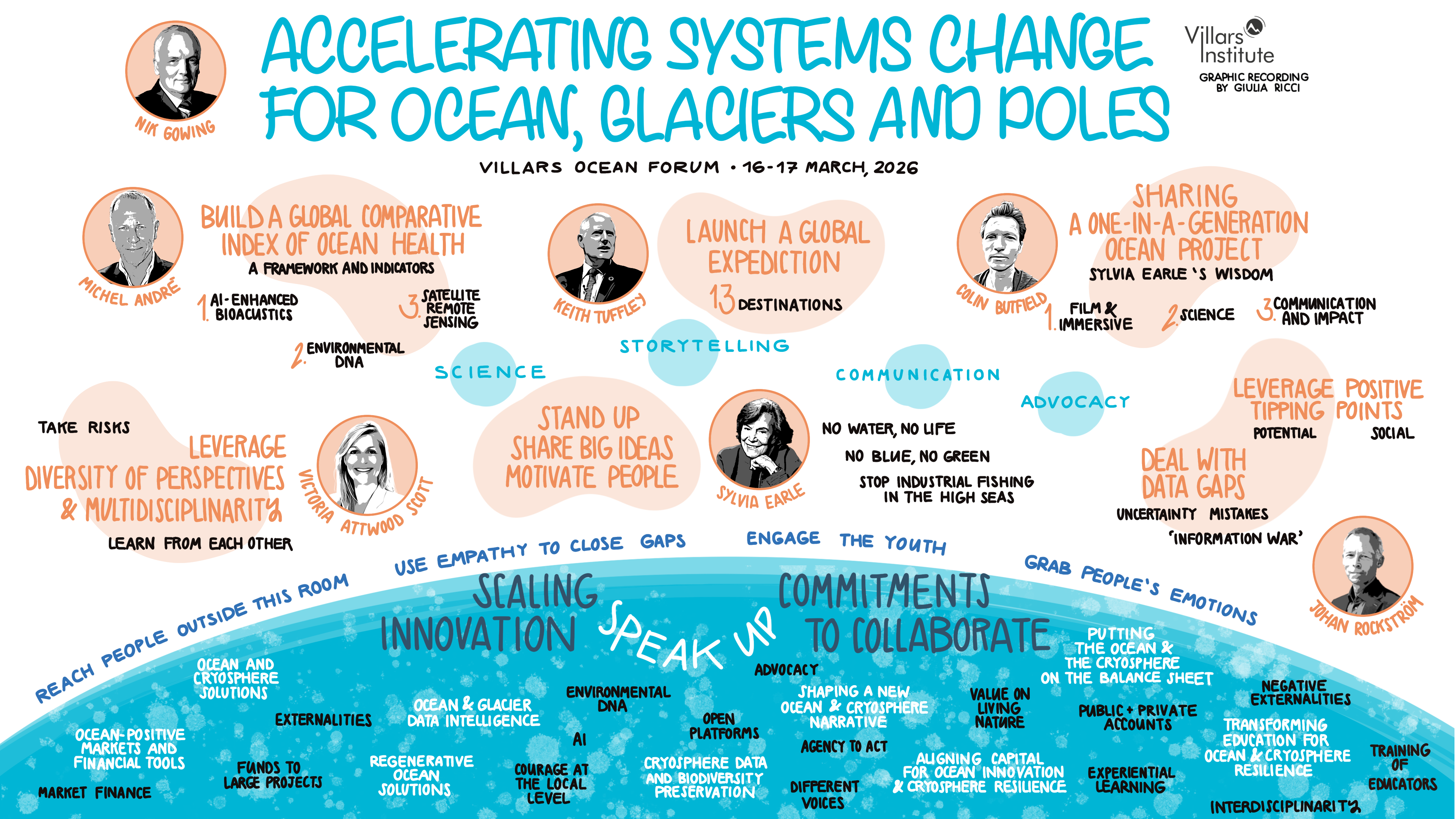

Ideas from the speakers
Despite growing scientific understanding of ocean, glaciers and poles, action continues to lag behind what is required. This session makes clear that the central challenge is not knowledge, but the ability to act collectively and decisively despite uncertainty and systemic constraints. A key priority identified is the need to halt industrial fishing on the high seas, reflecting the urgency of protecting ocean systems. At the same time, the session highlights that meaningful progress depends on both individual and collective contributions. While no single actor can address the full scope of the challenge, each person has a role to play, and cumulative actions become a powerful driver of change.
A central barrier to progress is identified not as ignorance, but as uncertainty within the scientific community, coupled with difficulties in communicating complex risks. Ongoing debates - such as those surrounding the potential shutdown of the Atlantic Meridional Overturning Circulation (AMOC) or the collapse of coral reefs - make it difficult to communicate risks clearly and act with a unified voice. However, it is emphasized that in some cases the level of risk may already exceed acceptable thresholds, pointing to the need for more immediate and precautionary responses. Strengthening primary data collection and enabling greater alignment across the scientific community are seen as critical to supporting clearer and more decisive action.
The session also underscores the need to address structural barriers within the global economic system. Sustainable choices must become the easiest and most accessible options, so that individuals and societies can act without requiring constant deliberate effort. Achieving this requires both bottom-up engagement and stronger top-down leadership, as well as greater courage to confront misinformation. Policy and regulatory frameworks are essential drivers of progress, but their effectiveness depends on a willingness to take economic and reputational risks. The discussion also highlights the opportunity to transform ecological tipping points into positive social and economic tipping points, and to view planetary boundaries as drivers of innovation.
The session further introduces a new large-scale ocean initiative centred on Dr. Sylvia Earle, described as a “one-in-a-generation” project designed to mobilise science, storytelling, and global action, . The initiative is structured around three interconnected pillars - scientific research, film and immersive experiences, and communications and impact - aimed at strengthening both knowledge generation and public engagement, while also celebrating Dr. Sylvia Earle’s tenth decade dedicated to the ocean. At its core, the project proposes a new scientific framework for ocean health based on a unified index that integrates multiple dimensions of marine ecosystems. A central component of this framework is the use of whales as biological sentinels, whose behaviour and acoustic signals provide measurable and early indicators of ecosystem change and stress. This approach is supported by three complementary tools: AI-enhanced bioacoustics, environmental DNA (eDNA), and satellite remote sensing, which together connect animal behaviour, ecosystem dynamics, and large-scale environmental conditions. By integrating these elements, the initiative aims to support science-based solutions and accelerate global action for ocean stewardship.
Insights from the audience
The plenary session underscored a fundamental paradox: while the knowledge, innovations, and resources to address ocean and cryosphere challenges already exist, systemic misalignment across finance, governance, and societal values continues to impede meaningful progress. The following synthesis reflects the key insights and report-backs from the parallel sessions, bringing together diverse perspectives into a coherent set of overarching themes. The discussions highlighted that the central barriers are not primarily technological, but political, economic, and structural. Although innovative solutions are available, their scaling is constrained by misdirected capital flows, fragmented governance, and the continued subsidization of harmful activities. Participants emphasized that finance alone will not resolve these issues; rather, the critical challenge lies in how capital is allocated, as current systems still prioritize extractive uses of nature while leaving living systems largely unvalued. A recurring theme was the urgent need to redefine value by integrating ecological, social, and long-term considerations into financial and policy frameworks. This includes eliminating harmful subsidies, redirecting investments, and developing mechanisms that recognize the ocean and cryosphere as living systems essential to planetary stability. Importantly, participants noted that a lack of data is not the primary constraint; instead, the gap lies in translating existing knowledge into coordinated and effective action. Governance and political will emerged as decisive factors. Despite the availability of viable solutions, implementation is often obstructed by political resistance and insufficient accountability. Participants stressed the importance of leadership and courage, particularly at local and national levels, to enforce regulations and challenge harmful practices such as illegal fishing. Local action was framed as a catalyst for broader systemic change, countering the tendency to delay progress in the absence of international consensus. Scientific innovation, particularly in emerging fields such as cryosphere biodiversity, was identified as both urgent and promising. Rapid glacial retreat is leading to the loss of largely undocumented microbial ecosystems with significant potential for scientific and industrial applications. This highlights the need for enhanced global coordination, open-access data infrastructures, and inclusive research initiatives to document and preserve these resources. Finally, the role of narrative and public engagement was emphasized as critical for driving action. Effective storytelling and emotionally resonant communication can bridge the gap between scientific understanding and societal response. Overall, the session concluded that achieving meaningful progress requires systemic alignment across finance, governance, science, and society, moving from fragmented efforts toward integrated, scalable solutions.