


Ideas from the speakers
Among other factors contributing to the unprecedented rate of global biodiversity loss, our financial system has played a significant role.
To begin the session, an exclusive film highlighted the idea of gold mining in the Amazon as a case study. Since our financial system values gold more highly than it does the rainforest, there is an incentive to extract gold from the ground (often using harmful methods such as mercury leaching) and place it in vaults. The individuals taking part in this are not inherently at fault. Rather, it is the system that incentivises well-intentioned actors to make harmful decisions.
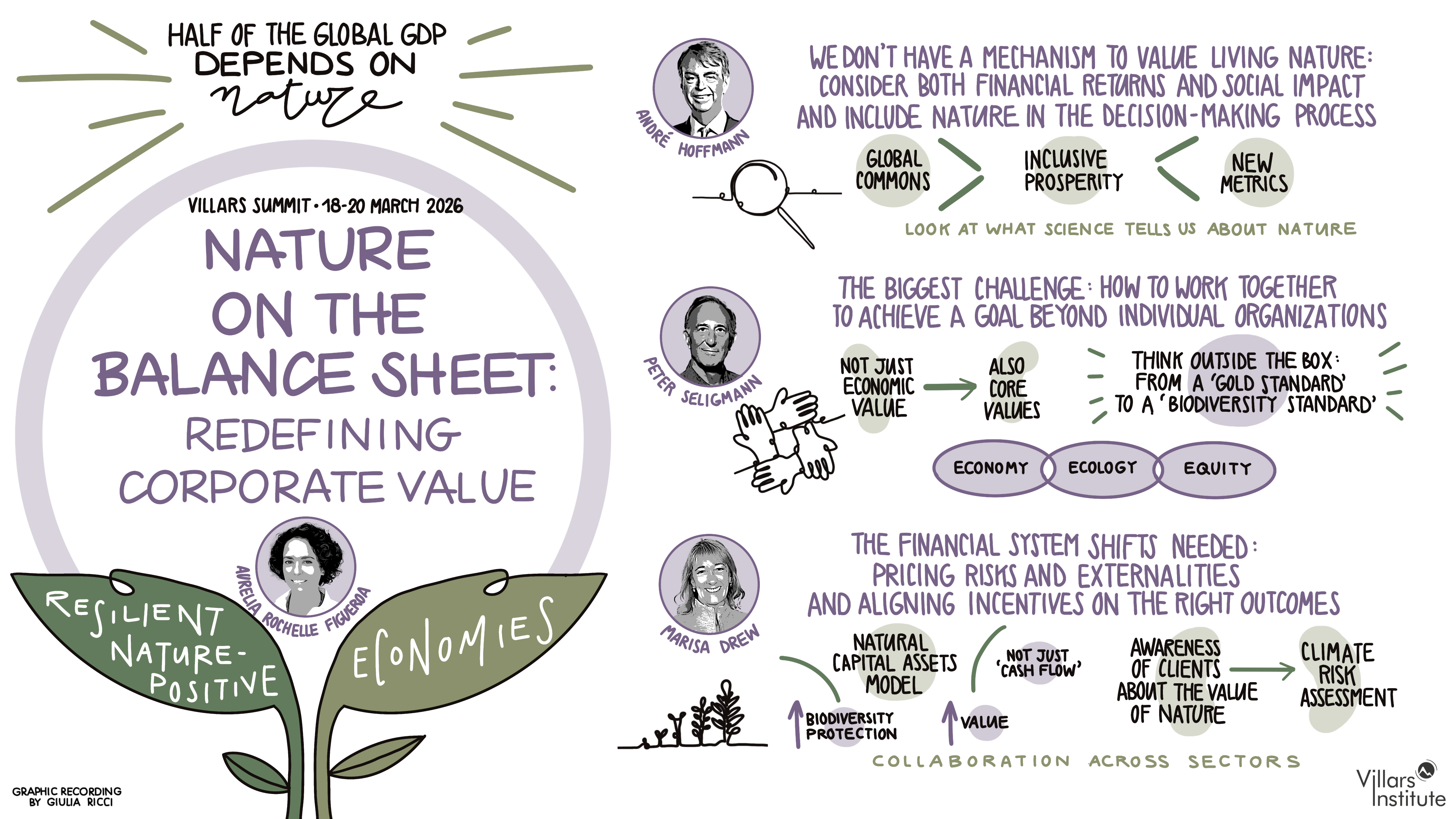
The idea of putting nature on the balance sheet is relatively simple: if living systems can be priced, it becomes possible to quantify the value of the natural world to the human economy. By expressing this value numerically on corporate balance sheets, rewarding and incentivising actions that protect and expand natural capital becomes feasible. One speaker kicked off the discussion by immediately putting the key challenge into perspective: if biodiversity is our metric for nature, the core issue is that we do not yet have a mechanism to value life. Commodified products of nature are assigned value—for example, cut trees are valued according to the weight of their timber. However, a living tree is worth more because of the ecosystem services it provides, such as clean air, fresh water and habitat. Understanding how to measure this type of value is key to protecting the natural environment. As one speaker noted, our mismanagement of the planet ultimately stems from the fact that we do not value it enough.
Understanding how the current status quo is shaped by the financial system is key to considering potential courses of action. One speaker from the banking industry noted that changing the system from within is difficult because current regulatory incentives encourage financial institutions to prioritise safe, high-cash-flow assets. As a result, actors within the system often need to be convinced individually rather than through a single “blanket” solution. The message from engaged institutions to corporates has increasingly become one of requesting financial incentives to reduce the intrinsic penalties associated with engaging with nature under the current framework. Another significant challenge, mentioned by multiple speakers, is the belief that models placing nature on the balance sheet simply will not work. It is still a relatively new idea to consider nature as an investable asset. Financially minded individuals often struggle with this concept because nature is not a company and does not generate annual recurring revenue or cash flow. As a result, valuation is less straightforward than it is for traditional financial assets.
Interestingly, one speaker mentioned that gold provides a useful comparison. Society values gold for its properties and therefore treats it as an investable asset because there is a collective belief that it has intrinsic value. This enables markets to assign it financial value. The speaker argued that by applying similar logic to nature, it may be possible to create a “buy and sell” market that allows direct investment through a fiscal mechanism known as Natural Asset Corporations (NACs). In this model, large landowners place ecosystem services into a corporation, generating carbon and ecosystem-service revenues as returns. One speaker highlighted an innovative model being implemented in Brazil that combines equity, debt and credits to improve outcomes.
Beyond the financial system, speakers argued that other levers must also be considered. One anecdote from New Zealand described a group of major international conservation organisations choosing to subordinate their individual brands to a higher cause, working together to explore how nature can become an investable asset class. The speaker suggested that beyond business and entrepreneurship, a broader cultural shift is required—one that reconsiders humanity’s relationship with nature and how much it is valued. According to the panel, halting nature loss beyond 2030 requires not only incorporating nature into decision-making, but also carefully considering impacts on social, natural and human capital in order to maximise inclusive prosperity.
Insights from the audience
Global crude oil production and use exceed 105 million barrels per day. In response to growing energy demands, many multinational oil companies are beginning to invest in cleaner forms of energy to power their operations. One audience member questioned the role these companies play in the energy transition, asking whether investing in such companies could support broader progress given that step-by-step change may be more realistic than immediate transformation. Panel responses suggested that consumer demand for cleaner energy and more sustainable practices has indeed increased, although no definitive position emerged from the discussion.
Another point raised concerned adjusting pricing according to sustainability metrics. With carbon prices in the EU sitting at around €80 per tonne, the panel suggested that shares may possess stronger financial characteristics than credits as an investment instrument. It was argued that bundling assets can improve the financial properties of investments. If companies were required to internalise environmental costs, these costs would be reflected in the prices of goods and services. Consumers, in turn, would be able to make more informed decisions about the companies they choose to support.