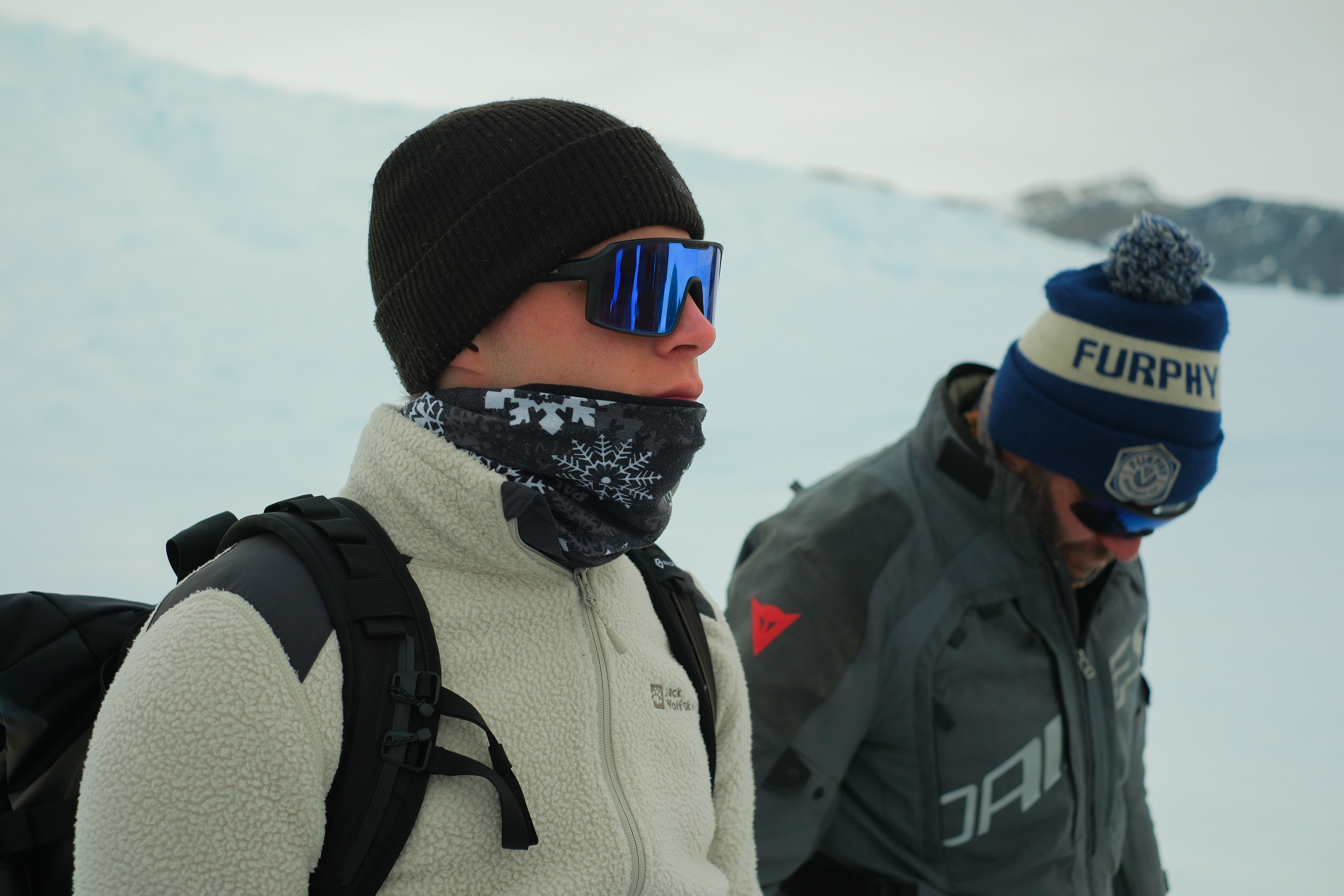
There is a moment late at night when the camp falls completely silent. Everyone is asleep, yet it is still light. The sun never fully sets, hovering above the horizon and casting a pale, constant glow across the landscape. No voices, no engines, no movement. Nothing human interrupts the stillness. The silence is calm, but it feels unusual, almost unsettling. Not because something is wrong, but because there is nothing left to distract you from where you are. In that moment, scale becomes difficult to ignore. The environment feels vast and powerful, and at the same time fragile. You become aware of how small you are, not in a dramatic or threatening way, but as a simple fact.
Alongside that realization comes another: what we do carries weight. Both are true at once. We are small, and our actions matter.
What stayed with me most during the expedition was not a sense of danger or urgency. We were fortunate with the conditions. Nothing went wrong. And it was precisely that absence of disruption that made things clearer. Without pressure or crisis, responsibility could not be deferred. There was no immediate problem to solve, no visible emergency to respond to. Responsibility was simply present, quiet and constant.
That clarity is difficult to arrive at in more familiar environments. It is often shaped by urgency, deadlines, or visible problems that demand attention. Here, without those pressures, responsibility is not reactive. It is something you recognize before action is required, and that shift changes how you understand your role within it.
Responsibility Without Urgency
What emerged was not a feeling of burden, but of direction. Responsibility did not feel heavy; it felt specific. It became less about fear or guilt and more about intention, about recognizing that decisions have consequences, even when those consequences are delayed or distant. Being there made that understanding concrete. Responsibility stopped being abstract, something expressed through targets or global figures, and became practical, something that shapes how you act and how consciously you occupy space. Without urgency, there is no external pressure forcing action. Responsibility becomes self-directed. It depends on whether you choose to acknowledge it and what you decide to do with that awareness.
These ideas were not new. Awareness of environmental fragility existed before the expedition. But there is a difference between understanding something and carrying it. That shift is subtle, but significant. It moves responsibility from something you agree with to something that informs your decisions.
In that sense, responsibility is less about reacting to problems and more about anticipating them. It is defined not by moments of crisis, but by the consistency of how you act when no one is asking you to.
The Meaning of Being There
Responsibility does not look the same for everyone. It does not require identical actions or a uniform response. For some, it may be practical: changing habits, reducing impact, paying attention to what is left behind. For others, it may take the form of conversation, advocacy, or raising awareness. The form matters less than the intention behind it. Awareness creates responsibility, whether it is acknowledged or not. And once it is recognized, it becomes difficult to ignore. There is a tendency to separate observation from consequence, to visit, to experience, to be present without fully accounting for what that presence implies. But presence is not neutral.
This is not about assigning blame or rejecting exploration. It is about being deliberate. If we are present, then how we are present matters. One of the more challenging aspects of the experience was ensuring that being there had purpose, that presence translated into something beyond the moment itself. That question does not end when you leave. It follows you back quietly, and remains. The expedition did not change what I believe; it clarified it. Responsibility does not always appear as urgency. Sometimes it emerges in stillness, and once recognized, it cannot be set aside.
The question that remains is not what needs to be done at scale, or what others should change. It is more direct: now that you are aware, what is your role?