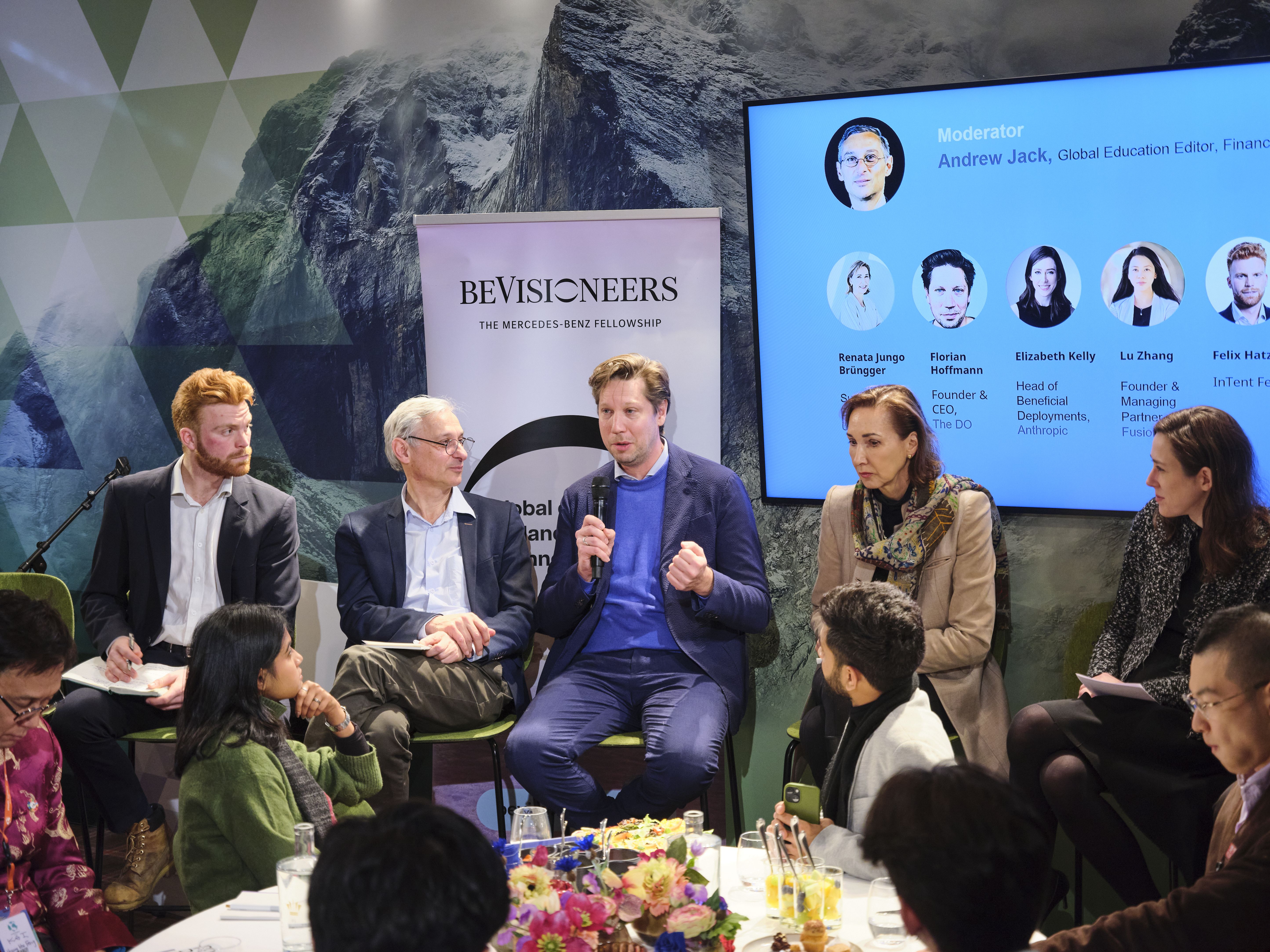



Without a doubt, AI development is today’s hottest topic amongst professionals, entrepreneurs, and the youth. The session opened with a quick reality check from a youth survey: about 49% of young people reportedly see AI changing opportunities in the job market, and around 40% linked it to changes in education (figures cited in the room). The message is clear: young people already feel the rules shifting.
Speakers described AI as a disruptor that has moved beyond the tech bubble. One statistic shared during the session suggested that AI is already affecting roughly a third of industries, and education is among the most visible, with many people saying AI is now an “integral” part of how they learn and work. The overall tone was cautiously optimistic: excited by the capability, but aware that without responsibility, we create new gaps faster than we close old ones.
The corporate perspective: investment needs a human plan
When it came to big corporations, the speakers emphasized how AI cannot be treated as “just a tool.” The role of ethics, according to the panel, needs to be considered when integrating AI and humans as one system. Companies are devoting billions of dollars to AI inclusion, and some speakers framed 2025 as the beginning of serious incorporation across industries.
But investment in technology isn’t sufficient if people arrive in the labor market “lost.” Several speakers emphasized the gap between education and work: students and early-career workers are expected to use AI, yet many were never taught how it works, where it fails, or how to use it responsibly. Education, in this sense, becomes part of corporate responsibility.
The panel also highlighted how AI is already reshaping hiring. Candidates use AI for résumé preparation, while recruiters use AI to filter applicants. The warning is that filters can miss the best talent, turning recruitment into a game of chance rather than capability. A second theme was scale. Speakers noted that AI has lowered the entry barrier for startups and founders, allowing smaller teams to grow faster, and sometimes compete in spaces once reserved for large corporations. AI allows small teams to build very large outcomes, because it compresses time, tasks, and headcount.
The youth perspective: access, design, and speed
A BeVisioneers fellow emphasized the urgent need to incorporate the youth perspective when it comes to accessing AI tools. Many young people feel left behind because AI is moving at an unprecedented pace, and access is uneven. The youth should not only be included in access, but in the design of codes, allowing them to shape their own paths and destinies. One example raised was real-time feedback: creating channels where communities can respond to AI behavior while it evolves, so the system learns from lived experience rather than assumptions. The same logic was applied to corporate settings: companies should not design “for” people without designing “with” them.
Furthermore, the youth perspective raised concerns about entry-level roles. Panelists suggested that AI could significantly impact entry-level work within the next five years, with some expressing concern that up to 50% of such roles may be automated. Entry-level work has traditionally been a training ground, and if it disappears, we must redesign how people build skills and credibility. This is directly linked to scale, as the panel noted that approximately 1 billion young people are expected to enter the workforce by 2030. The idea of training for one career no longer exists: young people will change careers multiple times. Education and employers now face a new task: building adaptable individuals who don’t aim to follow traditional, linear paths.
Empowerment: top-down plus bottom-up
The panel returned to a two-direction model of change. We need top-down leadership to set guardrails, but empowerment must also come bottom-up so people feel capable of building their own path. When both exist, change actually sticks. This mattered most in the education debate. Speakers suggested academia needs to become more practical by better connecting learning to real-world systems. Some universities were described as hesitant to embrace AI, even though it will shape most careers. That hesitation risks widening the education-labor gap. Bias was also discussed as a societal responsibility. If models learn from biased systems, they can reproduce those distortions. The proposed solution was to diversify groups involved in the building, testing, and continuous improvement of AI.
Insights from the Audience
A key question surfaced from the audience: what about sustainability, and why does it sometimes feel missing from Davos conversations as a whole? The concern was that AI is often framed as productivity and profit, while its ability to accelerate circular economy systems, climate solutions, and biodiversity restoration is not always explored with the same seriousness.
On education, there was strong agreement that we must educate teachers, and do it without placing another load on already stretched educators. Audience members argued that AI training should be built into core teacher development programs, not treated as an extra task.
A lively debate followed: is university becoming less essential for a strong career trajectory? Some said yes, pointing to pathways where companies recruit earlier and train internally. Switzerland was mentioned as an example, with programs like the UBS Talent Pool offering young people an entry route into work. Others argued that academia often strengthens intellectual capability while still failing to emphasize practical decision-making in the real world: how to apply knowledge, test ideas, and learn through iteration.
Conclusion
The discussion made clear that AI is not only introducing new tools, but reshaping how opportunity is created and accessed. The question is not simply how fast the technology develops, but how quickly institutions, companies, and young people adapt alongside it. The next economic transition will depend as much on inclusion and preparedness as on innovation itself.