

Can natural and social systems science help shape responses to planetary crises? For Professor Saleem Ali, Distinguished Professor of Geography at the University of Delaware, delivering the 8th Villars Institute Distinguished Lecture this June, understanding how natural and human systems interact is central to addressing today's interconnected challenges. This relationship was one of the predominant themes that ran through his thought-provoking talk at the Villars Symposium, as he emphasized systems thinking for understanding the spectacular backdrop of the Swiss Alps beyond.
Renowned internationally for his work on materials, minerals, environmental health, safety, sustainability and peace, Ali's core argument is that planetary crises cannot be solved through narrow expertise or single-issue thinking.
In the lecture he argued that the most important insight is recognizing the connections between different systems. Climate change, biodiversity loss, migration, politics and economics are not separate issues; they interact across scales and sectors.
The most effective responses emerge when we understand how these systems interact, and when we design institutions that work with those relationships rather than against them. In his talk he also stressed the need for humility, cooperation and innovative solutions to address complex global issues, such as biodiversity and sustainability.
Ali argued that we need to move from thinking about ‘world order’ to thinking about ‘earthly order’, and toward governance that reflects how the Earth system actually works. In addition, we need to recognize that our natural order really is the one that defines all other orders, understanding that true success in tackling environmental issues will be multi-dimensional.
Here are eight key things we’ve learned from Professor Ali’s lecture about the power of academic multidisciplinary relationships and how natural and social systems science can help shape more effective responses to planetary crises to create lasting positive change.
Both natural and artificial orders must be acknowledged
One of the central themes of Professor Ali’s lecture was the power of more aligned relationships between the natural and the social. Planetary crises cannot be solved by climate science alone; they require understanding of human behaviourbehavior, politics, economics, culture and governance as well to make sustainable impact.
"For me, order goes back to the Greek roots of how we make sense of knowledge," noted Ali. "The Greeks used two terms for order; the first was ‘cosmos’, or spontaneous/natural - the way the universe works. The other is ‘taxis’ or artificial, where we create order."
In Ali’s thinking the world cannot just focus on the natural order to solve problems. Rather, he argued that effective governance requires understanding both natural and human-created forms of order, while recognizing that the latter ultimately exists within the former. "Environmentalists have struggled with this, because they just tend to focus on the natural order and resent artificial order. However, as the Greeks told us, both are really important."
…and yet, human systems are nested within natural systems
"A river going through the landscape may seem from a distance as a natural system, but in fact you could have communities living in there, political structures in there, and you can zoom in and zoom out, and that's the beauty of a system - you see those inherent connections at every scale," noted Ali.
He challenged the traditional sustainability model that presents society, economy and environment as equal circles. Instead, he argues that economic, political and social systems are embedded within the natural world.
"We cannot ignore the fact that there is going to be a nested system, so order is going to be subservient to nature."
Ali’s key message is that in order to live in the world meaningfully, we need to recognize these hierarchies. Responses to planetary crises must therefore recognize ecological limits rather than assuming nature can be endlessly adjusted to human demands.
Complexity is different from complicated
A car is complicated because its broken parts can be repaired individually, yet it is still a predictable system that can be ‘mended’. Ali notes that climate systems, ecosystems and societies are complex—a very different proposition—because they contain ‘unknown unknowns’ and produce unexpected outcomes.
This, he said, highlights the need for policymakers to be cautious about assuming simple interventions will produce predictable results.
"Complexity is an emergent phenomenon […] that's where humility comes in again. You need to know that there are things which are unknowable. There may be something fundamental, structurally there that we will never be able to figure it out, and that itself is important to recognize."
Diversity creates complexity, but also resilience
"When you have diversity or tension, you have conflict because you are wrestling with that complexity, but eventually you can get some mechanism whereby you get some equilibrium and stability, also," said Ali.
Using the example of milk swirling in coffee to illustrate movements within migration and social change, he demonstrated how periods of diversity and mixing often create instability and tension before new forms of adaptation, equilibrium and resilience emerge. Scientific and social communities should therefore expect disruption during transitions rather than treating it as failure.
Sustainability requires both ecological and social foundations
Ali praised the combination of Johan Rockström's planetary boundaries framework and Kate Raworth’s social foundation model and theory of ‘doughnut economics’ as examples of natural and social sciences that could be synthesized to produce a more impactful overall perspective. Together, they provide a framework that protects both the Earth's ecological limits and the social foundations needed for human well-being.
He asserted that a sustainable future must protect ecological limits while ensuring people have decent lives, education, health and opportunity – and environmental goals cannot be pursued without social justice.
"You need to have a certain quality of life, a certain level of income," he said. "You can't just be calculating whether you're going to have these planetary boundaries being met. [People] need to have a minimum level of well-being."
Trade-offs are unavoidable
Systems thinking reveals that there is rarely a perfect solution and Ali noted that society may not be able to maximize biodiversity, economic development, education and personal freedom simultaneously. Managing planetary crises means navigating trade-offs transparently rather than pretending that win-win solutions always exist. Rather than optimizing every objective at once, systems thinking requires making informed choices about what can realistically be achieved.
For Ali, such bald honesty is necessary, however uncomfortable it may be, to make meaningful progress:
"You will probably end up with a suboptimal outcome. You will not be able to have both the best outcome for biodiversity and make sure all the children in Africa go to school and have a decent quality of life."
International cooperation can solve shared-resource challenges
For Ali, the Antarctic Treaty System offers tangible proof that countries can cooperate to manage globally important ecosystems. Even at the height of the Cold War, rival nations created a shared governance model for one of the world's most important commons, and that success suggests similar approaches could be developed for minerals, climate, biodiversity and other global commons.
Is the idea of global hierarchy and dominance the biggest block to progress? It’s a question Ali poses.
What’s needed, he pointed out, is a fundamental change in our understanding of the world’s divisions:
"We need to move from world order to earthly order, which is a much more systems-oriented approach to thinking about governance."
Systems thinking helps identify reinforcing and balancing feedback loops
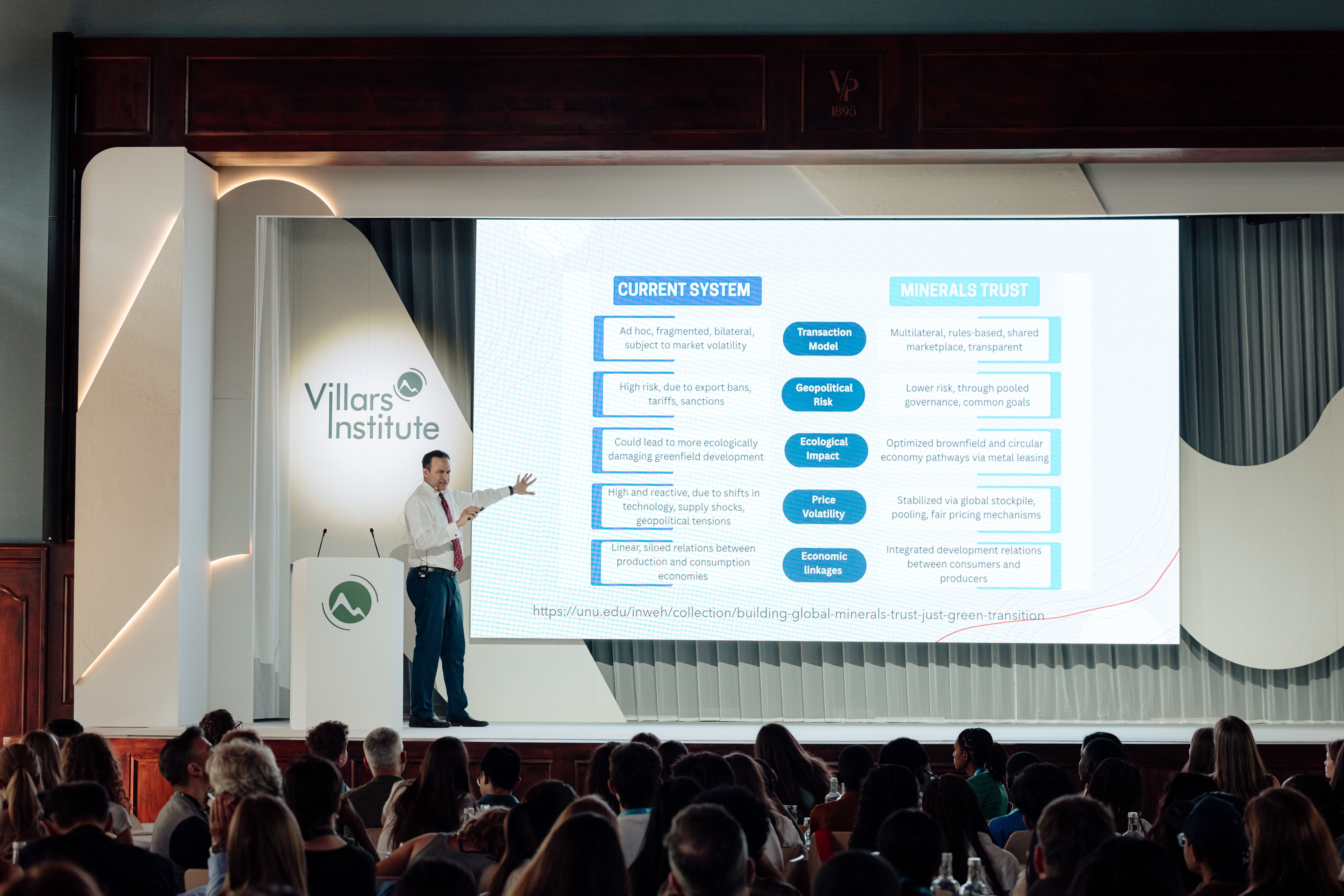
Ali uses electronic waste and critical minerals as examples of how systems maps reveal feedback loops. Some actions create vicious circles that worsen problems, while others create balancing loops that stabilize systems. Understanding where these loops exist helps identify interventions that reduce unintended consequences and create more resilient systems.
"You want to figure out if something is going to balance the feedback, or will you get what we call a vicious circle, reinforcing you, that's going to lead to worse outcomes," noted Ali, who asserted that understanding these feedback mechanisms is fundamental to designing effective interventions for climate, resource use and pollution.
"It’s what is called the safe operating space for humanity, and that's what systems thinking makes you do."