
A Challenging Moment in History
Reflecting on one of the Villars Symposium’s plenary sessions, a Villars Fellow shared their experience exploring systems leadership alongside their high school peers. “Humans are social creatures and we love doing things and spending time together,” they wrote. “This applies to every one of us. Love is so powerful and when we work together we not only have fun but impact.” Importantly, they noted, “P.S. I will never forget the laughter.” Another wrote that the same session “reminded me of how I feel in society. I enjoy getting involved and stirring things, but I need to recharge. Sometimes it's nice to just sit or stand in silence with someone and have that sense of comfort. Silence allows for a less pressured environment. We must respect when people need that.”
Laughter. Recharging. Silence. A less pressured environment.
These words, and many others that Villars Fellows shared about their participation in the “Systems Leadership: From Theory to Practice” workshop strike us as particularly compelling. They represent the language of a younger generation that feels the weight of society’s difficulties while also aspiring to address preeminent issues. They speak a language that is universal; the desire to recharge, to laugh, and to be enveloped in silence represent common yearnings, ones which feel particularly salient at this moment in history.
The challenges facing society are in no short supply. Daily are the sobering reminders of seemingly intractable matters with which leaders and citizens must contend. A brief scan of the most pressing societal issues requiring attention – worldwide political fracture, global sustainability concerns, international migration matters, and a host of others – presents a dizzying array of cross-border predicaments. Of course, such challenges are not restricted to the global space; issues such as changing food prices and emerging mental health concerns are felt locally, even personally. Whether in our nearby community or the institutions or nation-states to which we belong, challenges abound that are nuanced, intricate, and resistant to quick fixes. Often, such issues present as transboundary pain points, for it is across perspectives, beliefs, professions, institutions, sectors, and borders that conflict and contention surface and resolution awaits. They serve as reminders that contemporary demands can be complex, systemic, and dynamic.
Addressing such issues requires the input, ingenuity, and involvement of all – all citizens, leaders, and institutional types, and in the spirit of the Villars Institute’s work, all age groups. It has been our good fortune to work alongside members of a younger generation – the adolescents and emerging adults who comprise “Gen Z” – who have demonstrated their intention to serve as conscious citizens and systems leaders. Assuming their roles as leaders, though, has not been easy. Research indicates that the weight of transboundary issues has been acutely felt by Gen Z. In response to destabilizing climate change, for example, eco-anxiety, eco-distress, and climate anxiety have become embedded parts of young people’s lives. The challenges affecting adolescents and young adults are not merely transnational; they are transcendental. Today, loneliness prevails among the young (and the not-so-young) and Gen Z grapples with a collective sense of meaninglessness. With some facility, one could be left with the impression that doom and gloom represent prevailing sentiments among young people, particularly when previous generations, including our own, have declared that it is on them that the future depends.
But that is not the whole story.
Our work with young people, including a host of Villars Fellows, demonstrates that there is both desire and devotion among Gen Z-ers to channel their energy toward addressing complex challenges. Both of us have been moved by the multitude of young people who reject negative narratives and commit themselves to engaged, informed, and ethical citizenship and leadership. They are willing to speak up and act out, ensuring that vexing issues do not go unnoticed. Their spirit of constructive effort is inspiring, particularly since societal challenges emerge without an appointed leader to address them.
Villars Fellows and other young leaders serve notice that they are willing to meet the moment together – and not only collaborate but challenge the very notion of what it means to lead. Our own experience tells us that adults-in-waiting are more than capable of serving as tomorrow’s systems leaders – and some may be ready today. One Villars Fellow surmised that their own leadership path should involve “courage to initiate, motivations to amplify, and adequate constraints to direct.” To proceed with such purpose and conviction would be impressive for any leader, let alone one who is an adolescent.
Systemic Challenges Demand a Leadership Rethink
Exploring what it means to serve as a leader, and, in particular, as a systems leader, deserves close examination. More often than not, our search for society’s consummate problem solvers can lead to an obsession with identifying the überindividual. Today’s leadership lexicon reveals a fascination with problem solvers and power wielders. A search for “leader” synonyms surfaces descriptors such as “principal,” “superior,” “controller,” "strongman," and even “kingpin.” Leaders can be perceived as supreme, unassailable, and omnipotent, and as those who execute their duties alone. Even more, there is a perception that leaders should earn their standing through competitive supremacy rather than collaborative engagement.
The prospect of cultivating the leader-as-hero captures our imagination, but such a project is misguided. The complexity of contemporary challenges demands reconsideration of who a leader is, or should be.
We propose an approach toward leadership that is formative, collaborative, and marked by the ability to hold a brave space, or a different way of showing up when leadership is required. Systemic challenges require more than reflection and deliberation, or even intellectual horsepower. Formative development involves holistic, whole-person engagement – an approach that accounts for emotional, corporal, ethical, and spiritual aspects – all necessary, we believe, in the cultivation of future leaders. Recent research on the impact of climate change on mental health conveyed the severity of the issue on an individual’s overall wellbeing. One study participant offered: “I have all these anxious and depressed thoughts about climate change that are making my stomach hurt.” What happens around us can deeply impact what happens within us. Our minds and our hearts – and our stomachs – can hurt. Our whole selves matter.
The multidimensionality of societal challenges requires wholeness; to solve vexing problems, a variety of perspectives, insights, and ideas need to be involved, starting with an account of our own motivations and inclinations. A focus on our interior development, including awareness of how we show up alongside others, ought to feature in formal and informal learning. Such education starts with giving space for young people to honestly share how they are feeling. Understanding the entirety of ourselves and our capacities not only allows individual meaning and purpose to emerge but is necessary to realize change in communities, institutions, and society more broadly.
While leadership starts from within, it necessarily extends beyond individuals. By knowing ourselves, we realize a deeper connection to others – and that connection is fundamental to realizing meaningful change in the world. An overemphasis on leaders as individual actors can mean that communal and relational efforts – the work of teams, networks, and communities – can get short shrift. Community and connection matter; leadership, it has been argued, could be efficiently construed as partnership. In the face of an ever-changing world marked by VUCA and NAVI characteristics, alliances – those cultivated by societally aware leaders – play a consequential role in realizing impactful change. Local and global issues require collective insight; leaders, then, are called to build coalitions of willing participants and multidisciplinary experts through inventive, collaborative effort.
As well, a brave space posture challenges leaders to create the conditions for trust and courage to emerge in complex settings. Whenever power is distributed, the stakes are high, and outcomes cannot be controlled, brave leaders hold spaces for collective intelligence to take shape and be translated into impact. At its core, operating within a brave space involves showing up differently – leading with presence rather than position, choosing the “in-between” – stepping into spaces of shared responsibility, and moving from “holding spaces” to action – and doing so without reverting to hierarchy or control.
The Villars Institute’s emphasis on intergenerational dialogue represents an opportunity to conceive of solution-building while holding a brave space. Throughout the Villars Symposium, plenary speakers, workshop leaders, and participants rightly call for a changemaking approach that involves “Thinking—Feeling—Acting.” In Villars and other convenings that spotlight societal challenges, ample energy is devoted to thinking and acting (or thinking about acting!) elements of leadership. In far fewer instances, though, do we examine what the feeling dimension of change involves. No less important than engaging the cognitive or action-oriented parts of ourselves, attending to the emotional and sensory parts of our lives is vital.
Holding a Brave Space in Practice: A Case Study from Villars
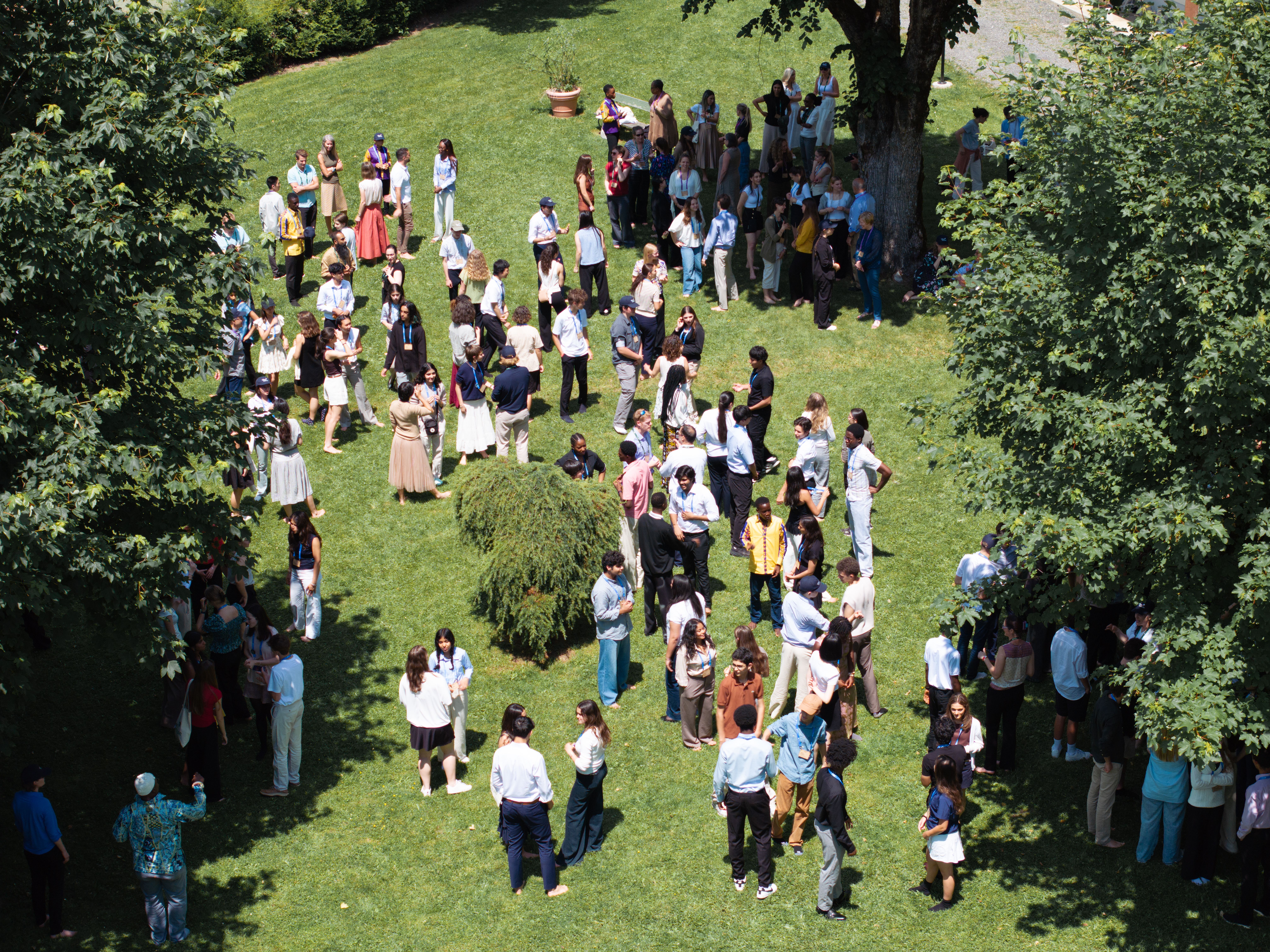
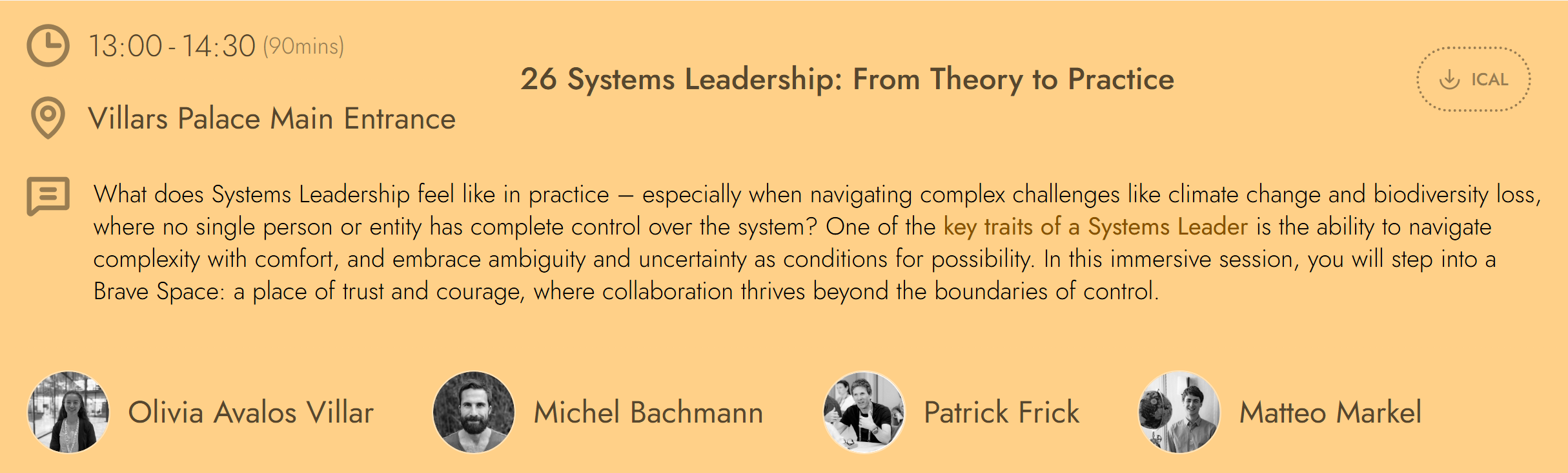
During the annual Villars Symposium, we entered into an experiment aimed at supporting the full expression of brave space for emerging leaders by putting systems leadership theory into practice. We held an outdoor session with no other objective than to embody systems leadership. There was no leader, per se, but there was a “container” – community-determined boundaries about how the group would interact – and an invitation to play. In that space, almost 200 young people, educators, and sustainability experts from around the world self-organized, created patterns, followed or resisted norms, and felt their way into systems leadership. We did not teach them about leadership. We helped them experience it.
Throughout the session, students and adults connected and held the space together as fellow explorers rather than competing agents. Challenged to convene without speaking, they found creative ways to communicate and convey ideas. Perhaps battling their own inhibitions, they danced and motioned and placed their arms around one another to signal “I’m on your team” or “Let’s try this together.” Courageous and collaborative, they were inclined to think, act, and fully feel, allowing themselves to notice the ways their bodies and their hearts spoke to them.
What they shared about their experience in retrospect was insightful. Students talked about wonderment and adaptability, and of inner happiness and of micro-connections. They reflected on being present; multiple times, participants wrote about what they noticed and observed – about themselves, about others, about their environment. Inspired by what transpired, one student commented, “Human connections are absolutely beautiful and we should actively seek them.” Another: “It is all about connecting, embracing each other, and being together.” Multiple students wrote of a desire to flourish. Importantly as well, creativity and playfulness featured in reflections; the session enabled one student to “dance, be together, and have fun.”
What stood out again and again in students’ reflections was the joy of connection. The joy of being in community. Students shared – and modeled – that systems leadership is embodied leadership.
Through their individual and communal reflections, the Villars Fellows have impressed upon us the following insights into what it means to work collaboratively:
- Neither a plan nor authority is needed to spark collective action. Systems don’t require full control or authority for leaders to shift them. One brave act – even spontaneous - can catalyze a cascade of actions, rippling out and altering an entire system. What matters are the conditions that allow for such bold actions to take place in the first place: safety to open up, permission to try, freedom of judgment.
- Connection before coordination. Community is the precursor to collaboration. People acted together not because they were instructed, but because they sensed belonging. Leadership emerged after connection – not before.
- The role of the observer is not a passive one. Being on the edge still affects the whole. Holding space includes the quiet, hesitant, skeptical. Inclusion means designing with them in mind. And sometimes the person who decides to follow actually leads.
- Patterns are contagious, so be intentional. In complex systems, patterns emerge and norms form quickly and stick. Early actions matter. Leaders must be aware of how visible behaviors get amplified – good or bad.
- Freedom needs boundaries to create space for courage and enable creativity. Brave space is not just “anything goes.” It involves creating a field of permission within invisible guardrails – values, intentions, and definitions of what is within scope and what is not. That paradox creates both comfort and courage to innovate and create.
Our own reflection revealed that the session did not represent a simulation. Instead, the exercise served as actual systems leadership in practice. Students and adults practiced what the world needs: the courage to act together and not alone. We were reminded through the workshop that brave spaces can be built anywhere: in a Swiss mountain village, in classrooms, in community centers, and in boardrooms. Authority is not needed to lead. Instead, it requires presence, trust, and a willingness to hold a space.
The Future of Systems Leadership According to Villars Fellows
Through their reflections, Villars Fellows also offered ideas on what a path toward a future leadership approach should entail – one that is formative, collaborative, and brave. Among their insights:
- Connection, community, and belonging. Fellows invoked language that included words such as together, others, everyone, community, embrace, group, connect, and comfort. Many participants highlighted how simple, shared actions foster a sense of connection—even without words. They made evident an appreciation for feeling part of something, and for the inclusivity that emerged when people let down their guard. In their own words:
“Everyone is so different and unique, but all work together so well!”
“If people don’t see you, you won’t be part of the ‘conversation.’”
“This exercise teaches me how to interact… not by words, but by body language.”*
- Emergence, influence, and systems thinking. Keywords in students’ writing included system, action, follow, change, pattern, leadership, and movement. Many saw how small actions could ripple outward. Leadership was often associated not with position but with initiating movement, creating new norms, or inspiring others—intentionally or not. In their own words:
“It begins with one person or action... this creates an emergence.”
“Systems can be ambiguous… motivations don’t necessarily align, but can generate a collective outcome.”
“It takes one person to catalyze huge change, completely altering the system.”
- Freedom, expression, and non-judgment. Words such as fun, free, different, bold, be yourself, comfortable, and creative appeared in reflective writing. The environment allowed for playful experimentation and courage. Participants valued freedom from judgment, leading to authenticity, creativity, and, sometimes, leadership by example. In their own words:
“Be different. Be bold. Do an action.”
“Just have fun. Be free. Everything will be okay.”
“Silence always helps to tap into our inner feelings.”
Viktor Frankl, writing in Man’s Search for Meaning, imparted the idea that the pursuit of individual success should not consume our waking moments. Instead, Frankl wrote, our dedication ought to be “to a cause greater than oneself.” Similarly, we would be well served to consider how our vocational focus engages our communal concerns – those that impact the very way of life for our families, our communities, and our neighbors, both near and far. We remain inspired by the work of fellow educators and leaders across sectors whose work addresses collective needs and whose model of leadership centers collaboration. We are particularly moved by the example of young people who commit themselves to causes greater than themselves, and we look forward to journeying with them – and learning from them – over the coming years and beyond. As we do so, we draw energy from their model of leadership and their perspective on building toward a hopeful future, including the words of a Villars Fellow who articulated that “If you are catching butterflies, build a garden, not a net.”
Building gardens, not nets. That sounds like holding a brave space to us.