
When Billie Eilish sang When the Party’s Over on stage at her OVERHEATED Climate Action Event in Berlin last May, the song’s title seemed strangely apt. The previous weeks had seen a torrent of distressing climate stories: the World Meteorological Organization (WMO) declared 2024 as the hottest year on record; more than 80% of the world’s reefs have been hit by bleaching; and biodiversity loss has been recorded across nearly every species on the planet.
On stage in Berlin that day was Johan Rockström, director of the Potsdam Institute for Climate Impact Research. The unofficial voice of Gen Z and one of the world’s leading Earth scientists might seem like unlikely bedfellows, but both are fervent advocates for nature positivity. Surpassing the 1.5°C temperature threshold would be cataclysmic, escalating extreme weather events such as floods, heatwaves, and hurricanes, making millions homeless. Even if all net-zero pledges are met, the planet is on course to reach 2.7°C this century.
Is the party really over for planet Earth? Make no mistake: the threat is serious – akin to a life-threatening, rapidly metastasizing disease. But as Rockström explained during the 6th Villars Distinguished Lecture, we might – just might – be able to steer the Earth back from the point of no return…
Earth has entered a worrying new epoch: how did we get here?
Rockström opened his lecture with an historical overview Earth’s environmental evolution:
9,700 BC: The Holocene epoch begins. Over the next 11,700 years, human civilization develops while the climate remains stable.
1776: Scottish engineer James Watt invents the first commercial steam engine, paving the way for the Industrial Revolution. Powered by coal, Watt’s steam engine increases demand for fossil fuels. Factories proliferate. Yet, the Earth’s plants and oceans absorb much of the carbon dioxide the factories belch out.
1952: The world enters the Anthropocene – a new phase of planetary history where humanity is in the “driving seat,” shaping the Earth’s environment more powerfully than the natural processes that have governed it for billions of years.
The economic boom following World War II brings a rapid rise in energy consumption and resource extraction. Biodiversity loss, ocean acidification, and deforestation follow.
2015-24: The hottest 10 years ever recorded. This “decade of deadly heat” (as coined by UN Secretary-General António Guterres) has largely been driven by human activity.
“Since the Industrial Revolution, our planet has been this remarkable friend,” said Rockström. “The more we abuse and release gases, the more the planet has responded by buffering… The problem is, over the last decade, we’ve started seeing cracks in the system.”
What science shows us today
Last year, the annual global temperature exceeded the internationally agreed 1.5°C limit for the first time (1.5°C is an average figure over a decadal time scale). If the world continues to overshoot this threshold (there’s an 86% likelihood this limit will be breached in one of the next five years, according to the WMO), Rockström warns, “things will get worse before potentially getting better… more clouds, more floods, more heatwaves.”
This acceleration in global warming is turning carbon sinks – natural ecosystems such as oceans, rainforests, and soils that absorb about half of carbon emissions – into carbon sources. The Amazon rainforest now emits a billion tons of carbon dioxide a year, mostly due to deforestation for cattle ranching and soy production. Somewhat paradoxically, the Arctic is also contributing to global warming. As the ice melts, it releases a third of the CO₂ stored inside the permafrost into the atmosphere.
In the same week Rockström spoke at Villars, research published in Earth System Science Data found the planet’s remaining carbon budget (the amount of CO₂ humanity can still emit without overstepping 1.5°C) could be exhausted within five years.
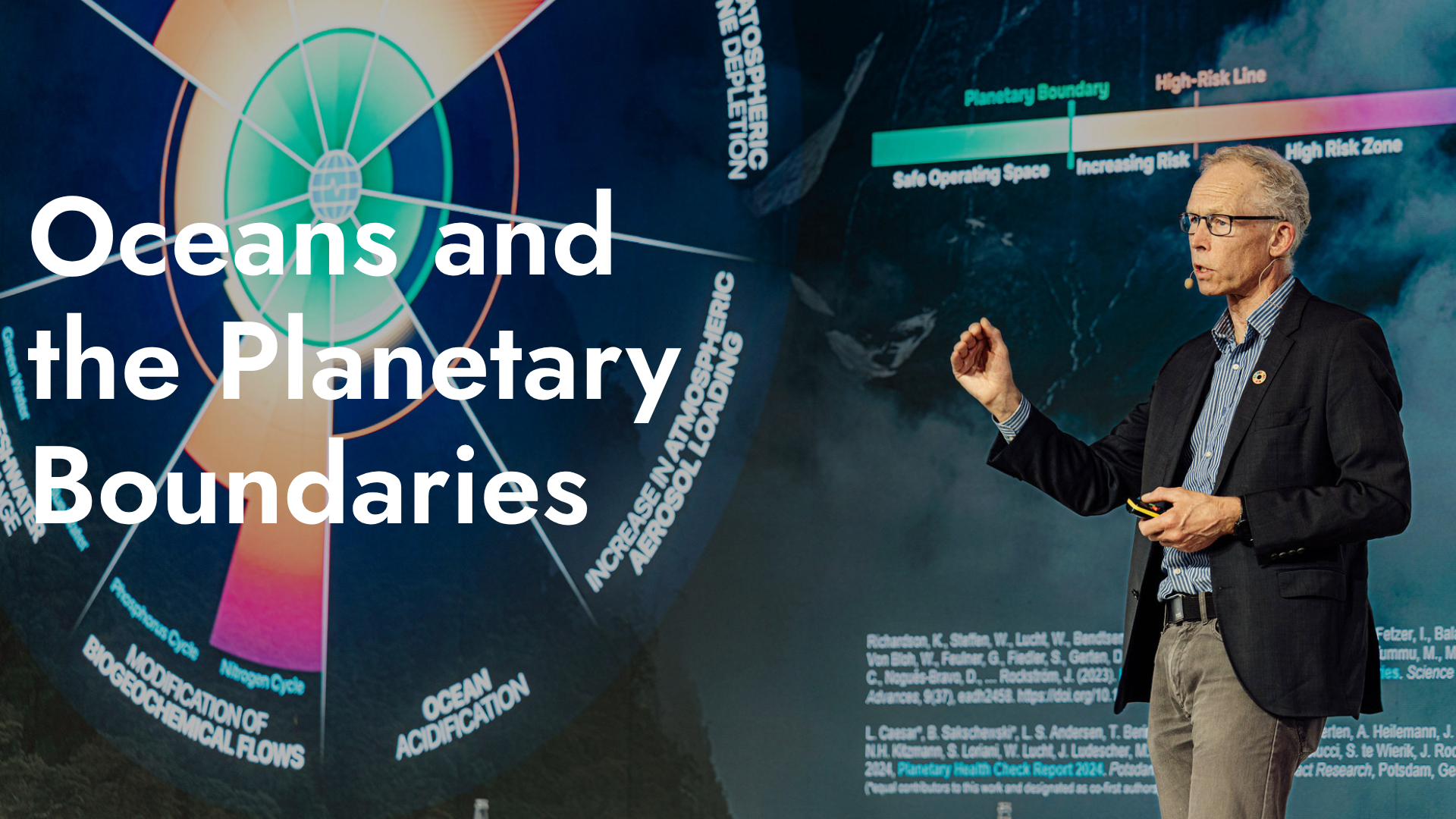
Meanwhile, research from the Potsdam Institute for Climate Impact Research last year found that six of the Earth’s nine planetary boundaries – system processes contributing to the planet’s stability, such as climate change, biodiversity loss, and freshwater change—have been breached. If we keep crossing these boundaries, Rockström warns the world will enter a “danger zone with irreversible changes.”
The tipping points
Scientists have identified 16 dangerous climate “tipping points” – thresholds which could trigger profound changes in the Earth’s system. Crossing these thresholds could lead to disruptions in weather patterns and further global warming. While these changes wouldn’t be immediate, they would be permanent if crossed. As Rockström explained, “You wouldn’t have a tsunami on the Monday morning after you crossed a tipping point. An ice sheet might take 1,000 years to melt, but it’d be unstoppable.”
Five tipping points are likely to be crossed at 1.5°C Warming:
Greenland ice sheet collapse Consequences: massive sea level rises, flooding coastal areas.
West Antarctic ice sheet collapse Consequences: a 5m rise in sea levels, endangering coastal cities.
Tropical coral reef die-off Consequences: huge biodiversity loss, threatening the 200 million people whose livelihoods depend on marine life.
Northern permafrost abrupt thaw Consequences: when this permafrost thaws, it will release carbon into the atmosphere, exacerbating global warming.
Labrador Sea current collapse Consequences: a shutdown of the Atlantic meridional overturning circulation (Amoc) which would disrupt rainfall patterns billions rely on for crops/food across the world.
4 things the world must do to avoid climate catastrophe
“We still have the opportunity for a stable, manageable and resilient Earth system that can support our and future generations,” said Rockström, highlighting the following key measures to get us there:
A global plan to phase out fossil fuels Fossil fuels like coal, oil, and gas are the largest contributor to the climate crisis, accounting for over 75% of global greenhouse gas emissions. Shifting to renewable energy sources such as solar, wind, and hydroelectric power is essential.
Countries must honor 2050 net-zero commitments 107 countries have pledged net-zero carbon emissions targets for 2050. These pledges must be upheld to reduce emissions.
The use of carbon dioxide removal (CDR) technologies CDR technologies, like those used by companies such as Climeworks, can capture CO₂ emissions from the atmosphere or from power plants and factories, and safely store them. To stay within the 1.5°C limit, we’ll need to remove 7–9 billion tons of CO₂ each year by the middle of this century, according to a 2024 University of Oxford-authored report.
Carbon credits/incentives and taxes Rewarding businesses for reducing emissions through carbon credits and imposing taxes on carbon-intensive activities can help make fossil fuels more expensive and renewables more viable. The market for CO₂ permits was worth $948 billion in 2023, according to the London Stock Exchange Group.
It’s not too late: Rockström on why we shouldn’t give up
When Rockström watched Billie Eilish perform When the Party’s Over in Berlin, he didn’t interpret the song’s sentiment as doomerism – a memo to Earth that it should pack away its metaphorical bunting and balloons before surrendering to the inevitable. Rather, he says, the end is near for the unsustainable fossil fuel era that has dominated for over 200 years.
“Scientifically, I’d argue that the game isn’t over – we still have a chance,” he said, highlighting the commercial argument for ditching the “dead-end” fossil fuel economy. If nations implement ambitious targets and policies to cut greenhouse gas emissions, it could result in a net gain of 0.23% to global GDP, according to a recent report by the OECD and UN Development Program, with advanced economies seeing a 60% rise in per capita GDP growth by 2050.
From renewables to carbon capture, Rockström believes the tools to tackle this are already available. “We can no longer say we can’t solve the climate crisis because we don’t have scalable solutions.”
Globally, progress is being made. In Norway, 94.3% of all new cars sold are all-electric, while in Denmark, battery electric vehicles make up 66.1% of new car registrations.
As for the apparent public inertia on environmental issues, the majority of the world’s population (between 80–89%, according to one global scientific survey recently published in Nature Climate Change) wants their governments to take stronger action on the climate crisis. Referencing sociologist Everett Rogers’ diffusion of innovations theory, Rockström said this weight of public opinion could unlock the change that’s needed.
For anyone cynical that the dial can’t be shifted, Rockström offered a hopeful reminder: when a growing “ozone hole” was discovered over Antarctica in 1985, within two years 197 countries had signed the Montreal Protocol, helping eliminate 99% of ozone-depleting substances. Today, the ozone layer is on track to be completely healed by 2066.
“We’re at a Montreal moment for climate,” said Rockström. “The science is settled. The policy agreements are in place… We just need to trust each other and become collective actors. But today, we live in a world drifting apart, rather than thinking of ourselves as one community living together on this little blue, beautiful marble of a planet.”