
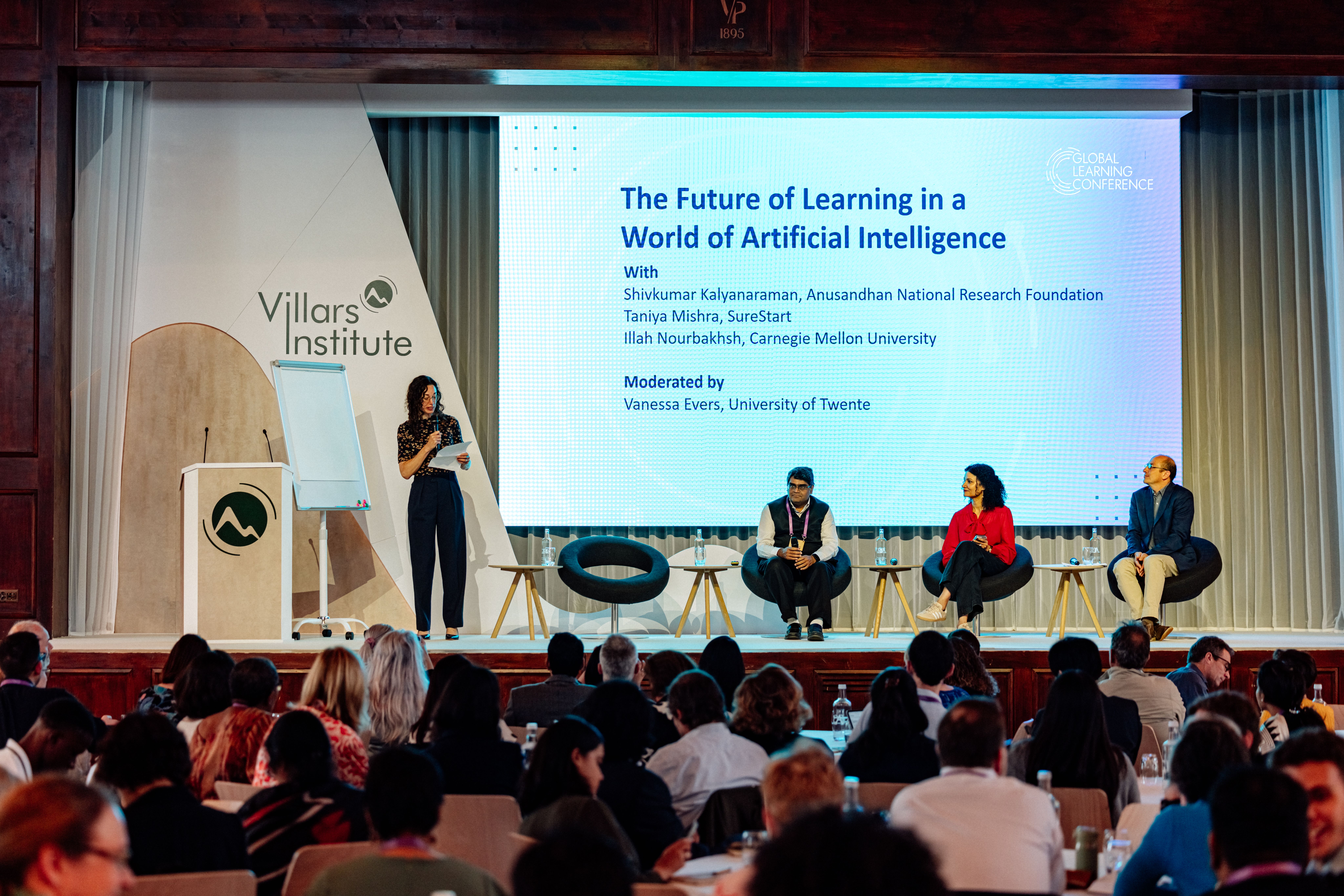

What is the future of learning as we contend with existential environmental challenges and exponential technological change?
As human activity pushes the planet towards critical tipping points, and artificial intelligence reshapes how knowledge is accessed, created, and assessed, education faces a moment of profound reckoning. What, how and why we teach — and learn — can no longer be taken for granted, particularly as widening global inequality continues to deny 250 million children access to schooling altogether.
These questions framed the Global Learning Conference, held in Switzerland in June 2025, which brought together world-leading educators, thought leaders, policy and decision makers, innovators, entrepreneurs, and multi-generational learners. Set against the Swiss Alps, the gathering focused less on immediate answers and more on long-term thinking, creating space to challenge assumptions, surface new perspectives and explore how learning systems might evolve to drive meaningful impact at scale.
If we need a yardstick to measure planetary health, then the world’s 16 climate tipping points – the environmental thresholds which could cause irreversible changes to the Earth’s system once crossed – offer a bleak barometer. Scientific evidence shows that six tipping points have already been passed, including the collapse of coral reefs and the melting of the Greenland ice sheet.
If global temperatures continue to rise, three more tipping points may be reached by the 2030s. By 2050, as much as half the Amazon could reach its tipping point, according to a 2024 study published in Nature, transitioning from biodiversity-rich rainforest to arid savannah-like ecosystems.
As the world develops solutions to forestall these scenarios, whether transitioning to renewable energies or net-zero pledges, one vital thread remains largely overlooked: education and learning.
As Subra Suresh, president of the Global Learning Council (GLC) and professor-at-large at Brown University, told the Global Learning Conference 2025, “If you’re worried about the future of the planet in 20 years’ time, [we need to] fix it now in the schools.”
Educating today’s youth — who will inherit the consequences of our action or inaction on the environment — is undeniably vital. Yet learning must extend far beyond schools and universities. It also encompasses professional training, teacher development, vocational education, and continuous reskilling across all stages of life. If we are serious about shaping a more sustainable future, lifelong learning is essential — not only to deepen individual understanding, but to empower leaders, practitioners, parents, and communities to drive change in every sphere of society.
The challenge? Education and learning are undergoing seismic changes.
After a pandemic which profoundly disrupted children’s education, stunted their communication skills and triggered a rise in pupil absenteeism, schools and universities are being tested by technological threats, from AI-crafted essays to a global digital divide.
Meanwhile, the World Economic Forum’s Future of Jobs Report 2025 reveals 39% of employers expect core skills to change by 2030, underlining the urgent need to upskill and reskill workforces. However, this is being impeded in many countries by a lack of state funding or employer support.
To help reimagine education and learning for our rapidly changing world, the Villars Institute co-founded the annual Global Learning Conference alongside the Global Learning Council (GLC) and United Nations Institute for Training and Research (UNITAR).
Held amid the majestic peaks of Villars-sur-Ollon, Switzerland, in June 2025, the Global Learning Conference brought together over 200 educators, entrepreneurs, investors, policymakers and philanthropists from 30 countries, as well as leading scientists such as Johan Rockström. Over two days, they discussed the future of learning by focusing on two major themes: AI & tech, and planetary boundaries.
AI IN EDUCATION: A DOUBLE-EDGED SWORD FOR THE FUTURE OF LEARNING
Generative AI chatbots such as ChatGPT, Gemini, Claude and Copilot have entered the classroom at vertiginous speed – one global 2024 survey by the Digital Education Council found 86% of students were using AI in their schoolwork; in the UK that number rises to 92% of undergraduates according to a report published by the Higher Education Policy Institute and Kortext. It’s leaving many teachers/educators “scared of the technology and of their students” according to UN special adviser Leonardo Garnier.
Students aren’t just using AI to draft essays; some use it to bypass traditional learning altogether: Pierre Dillenbourg, professor of learning technologies at Swiss Federal Institute of Technology in Lausanne (EPFL), told the Global Learning Conference how “students don’t attend classes or watch lectures, but just feed all the information into ChatGPT and ask for a summary”.
Teachers have turned to AI detectors to analyze the essays in their grading piles. But students are staying one step ahead, using tools such as Humanize AI which ‘humanizes’ or ‘scruffs up’ text by removing signs of AI-generated text, such as robotic language and faultless grammar.
Offloading their critical thinking to computers could damage students’ careers, as essays have long been considered a fail-safe tool for developing research, thinking, and writing skills. As Illah Nourbakhsh, professor of robotics at Carnegie Mellon University, told the Global Learning Conference, being able to synthesize information is vital for lifelong learning.
One paradoxical solution is to encourage students to "fail". Manu Kapur’s "Productive Failure" method flips traditional lecture-led learning on its head by giving students complex tasks to solve before they’ve been taught the underlying concepts. As they scramble for an answer, their cognitive resources are engaged, and they utilize their communication skills. Studies show Kapur’s approach – which has been used by Singapore’s Ministry of Education – improves both understanding and knowledge transfer.
Similarly, Nourbakhsh suggests educators present AI not as a “godlike phenomenon that’ll solve their problems, but as an error-filled discovery [tool].” If students learn ChatGPT and Claude are fallible – one 2025 BBC study found more than half of AI-generated answers had “significant issues” such as factual errors and misleading content – they’ll learn to scrutinize the tech, fine-tuning their critical analysis skills in the process.
“When students spend even a little time with AI, they start laughing at how bad it is,” Nourbakhsh said, “[which] builds their muscles and neurons allowing them to not only critically analyze today’s AI, but the politicians of tomorrow.”
Students will also need to understand AI’s impressive environmental footprint – the energy demands from AI datacenters are set to quadruple by 2030, according to a recent report from the International Energy Agency (IEA).
Even AI’s advantages in education/learning may still outweigh its downsides. The use of large language models (LLMs) to generate workbooks and bespoke lesson plans tailored to students’ educational needs, could reduce teacher workloads. Meanwhile, as Dillenbourg pointed out, agentic AI holds the promise of giving people personalized lifelong tutors.
And if humanity is to harness AI to solve some of its biggest problems – curing cancer or developing new green technologies to advance the net zero transition – future generations will need to master it.
THE NEXT FRONTIER IN EDUCATION ISN’T AI: IT’S EMPOWERING TEACHERS TO USE IT
That vision is already taking shape in Estonia. From September 2025, students in the Baltic state were given their own AI accounts, as part of the government’s AI Leap initiative. Digital ethics and self-directed learning will be baked into the program, which officials claim will make the country “one of the smartest AI-using nations, not just the most tech-saturated.”
Estonia was an early adopter of digital education, having provided computers and internet access for schools through its 1997 Tiger Leap project. Nearly three decades later, the investment is paying off: Estonia was Europe’s highest-performing country in OECD’s program for international student development (Pisa) 2022 rankings.
Rwanda has also been rolling out digital education across the country. The Global Learning Conference heard from Claudette Irere, Rwanda’s minister of state for education, who spoke about how digital education is transforming the curriculum from static knowledge to problem-solving and critical thinking.
While Rwanda and Estonia’s educational budgets are a fraction of G20 giants such as the US and China, a major theme at the Global Learning Conference 2025 was that innovation and impact isn’t the preserve of wealthier or larger nations. All can learn from their best practices. (The conference also hosted speakers from Ghana and Costa Rica).
Still, systemic change is difficult, especially when it comes to teacher training. Irere highlighted the challenges of equipping 12,000 teachers across Rwanda with the skills to use new technologies in the classroom. As SureStart CEO and Founder Taniya Mishra put it, “How do we make sure all kids have access to AI knowledge and literacy? The key is empowering teachers… We need to pre-skill teachers to upskill our students.”
Yet, 70% of teachers feel unsupported and underprepared, according to UNESCO, a factor which is contributing to the global teacher shortage: UNESCO also estimates the world needs 44m more teachers if education is to be delivered to every child.
Speaking at the conference, Garnier proposed paying teachers’ salaries on par with other professionals, offering better working conditions and listening to any concerns they may have vis-à-vis student behavior or technology.
THE EDUCATIONAL EMERGENCY: CLOSING THE GLOBAL LEARNING DIVIDE
The Global Learning Conference 2025 also focused on the vast disparities in global education and learning. While AI might be transforming classrooms in some parts of the world, UNESCO reports over 250m young people globally are out of school – mostly in developing nations disproportionately affected by the climate crisis. As such, there’s a dire need to equip communities with the knowledge and skills needed to switch to renewable energy and low-carbon technology, plus cope with the effects of climate breakdown.
In many parts of the world, conflict and repression robs children of an education, such as the Taliban’s ban on girls’ secondary school education in Afghanistan. Poverty is another factor: the cost of school fees and uniforms are sadly unaffordable for many families, who feel they have little choice but to keep their kids at home.
For those in education, the global funding gap is stark. Luxembourg spends $25,000 per student per year; some low-income countries spend just $55.
More investment is needed to narrow this gap. UNESCO’s Global Education Monitoring Report estimates global education needs an extra $100bn every year to meet the UN’s sustainable development goals (SDGs) of universal education by 2030.
One possible catalyst for change could be the Global Education Solutions Accelerator (GESA) which aims to fast-track education transformation across 10 countries, including Afghanistan, Kenya, and Tajikistan. Developed by philanthropic organization Dubai Cares, its CEO, H.E Dr. Tariq Al Gurg, told the conference, “We don’t have a Gavi [ the global vaccination group that has inoculated more than a billion children across the world] for education.”
Digital exclusion remains another barrier. The World Economic Forum estimates a third of the world’s population (2.6bn people) lack internet access. This not only disconnects them from online learning opportunities and learning the skills needed to navigate an increasingly automated world, but also from online platforms sharing climate education and sustainable practices.
Some innovative startups are attempting to bridge the digital divide. SureStart trains and mentors students from underrepresented communities in AI, before placing them in tech internships to help build a more inclusive pipeline.
LEARNING IN A CHANGING WORLD: EDUCATION AND THE FUTURE OF PLANETARY HEALTH
Last year, scientists warned seven of the nine planetary boundaries have already been breached, making the need to unlock tomorrow’s problems through the lens of learning even more urgent. As Suresh put it, “We can talk about the future of learning, but if we don’t connect it to reality, we’ll miss the opportunity.”
H.E. Dr Al Gurg reminded the Global Learning Conference 2025 that education underpins every one of the UN’s sustainable development goals (SDGs), foundational to solving everything from poverty to climate change.
Today’s young people agree. Last year, the Villars Institute’s Global Issues Survey polled over 300 15-22-year-olds from 58 countries and found 65% believe planetary boundaries such as climate change, ocean acidification and ozone depletion will highly influence their everyday behaviors.
One promising area is the rise of e-learning, projected to reach more than 1.1bn users by 2029. At the conference, Arun Venkat, senior program manager at the Global Learning Council, introduced Æther – an AI virtual learning platform and teaching assistant on sustainable development and planetary boundaries, launched earlier this year.
There are also barriers, such as lack of data-sharing among scientists (one 2022 Nature study found only 14% of contacted authors responded to data requests) and access. Shivkumar Kalyanaraman, CEO of the Anusandhan National Research Foundation (ANRF), told the conference about tools the program has developed to convert complex scientific papers into videos, podcasts, even posters.
The Global Learning Conference 2025 also saw the unveiling of The Villars Review, an online education publication advancing bold ideas at the intersection of science, society and sustainability, rooted in interdisciplinary research, intergenerational collaboration and systems leadership..
As Suresh noted, preparing for the next 20 years starts with how we educate today. However, young people are already stepping up with innovative ideas to support planetary health.
The EcoInnovators Challenge was an ‘ideathon’ which saw two student teams from India honored for their tech-driven environmental solutions. The Vanguards, from Delhi Public School in Bengaluru, developed an AI-based textile waste management system, which uses synthetic fabrics to make geotextiles. Team Navachar from OP Jindal University in Raigarh created an air quality monitoring solution and industrial emission alert system.
Both teams journeyed to Switzerland to attend the Global Learning Conference to showcase their solutions and receive their awards for winning the EcoInnovators Challenge – an ‘ideathon’ which invited students pan- India to create tech-led solutions to pressing environmental needs - Delhi Public School winning in the school track and Team Navachar in the university/college track.
The event also heard from 15-year-old Villars Fellow, Sai Narasimhan, who has developed a learning platform for youth in African communities living near national parks, aiming to empower the next generation of conservationists.
Of course, innovations to repair our planetary health can come from any generation, while it’s often senior members of communities who drive these changes. This is why lifelong learning is crucial, because, as Michelle Gyles-McDonnough, UNITAR Executive Director put it, “Lifelong learning connects generations, bridges the divide, and strengthens our ability to shift perspectives and empower communities… It remains one of the most powerful levers we have.”
Time might be running out to stop irreversible climate change. To ensure improved planetary health, education needs a reset – we need learning systems that equip us with the knowledge to understand our world, but also harnessing new tech such as AI to help change it.
The Global Learning Conference 2025 has already made a start. As Gyles-McDonnough told the conference’s final plenary, “The beauty of this place [Villars] is that it’s not just about conversation – it’s about action too.”
COMING UP
The Global Learning Conference 2026 in Africa is taking place19-20 February in Kigali, Rwanda. To join some of the world’s leading thought-leaders, innovators and visionaries working in learning and education, join us at https://glconference.org/