

The goal of this session was set from the moment the moderator introduced the key speakers: to identify a small number of quality biodiversity metrics, and to bridge the methods of measuring biodiversity from the scientific community to other sectors like politics, business and finance.
Active members of the audience discussed their undertakings and obstacles in streamlining scientific discoveries with broader goals of addressing biodiversity challenges. The first key point identified by the team of panellists was that there exists a barrier to the support of the private sector in these metrics. The reason is simple: there are too many metrics available, and the private sector does not know which ones to use.
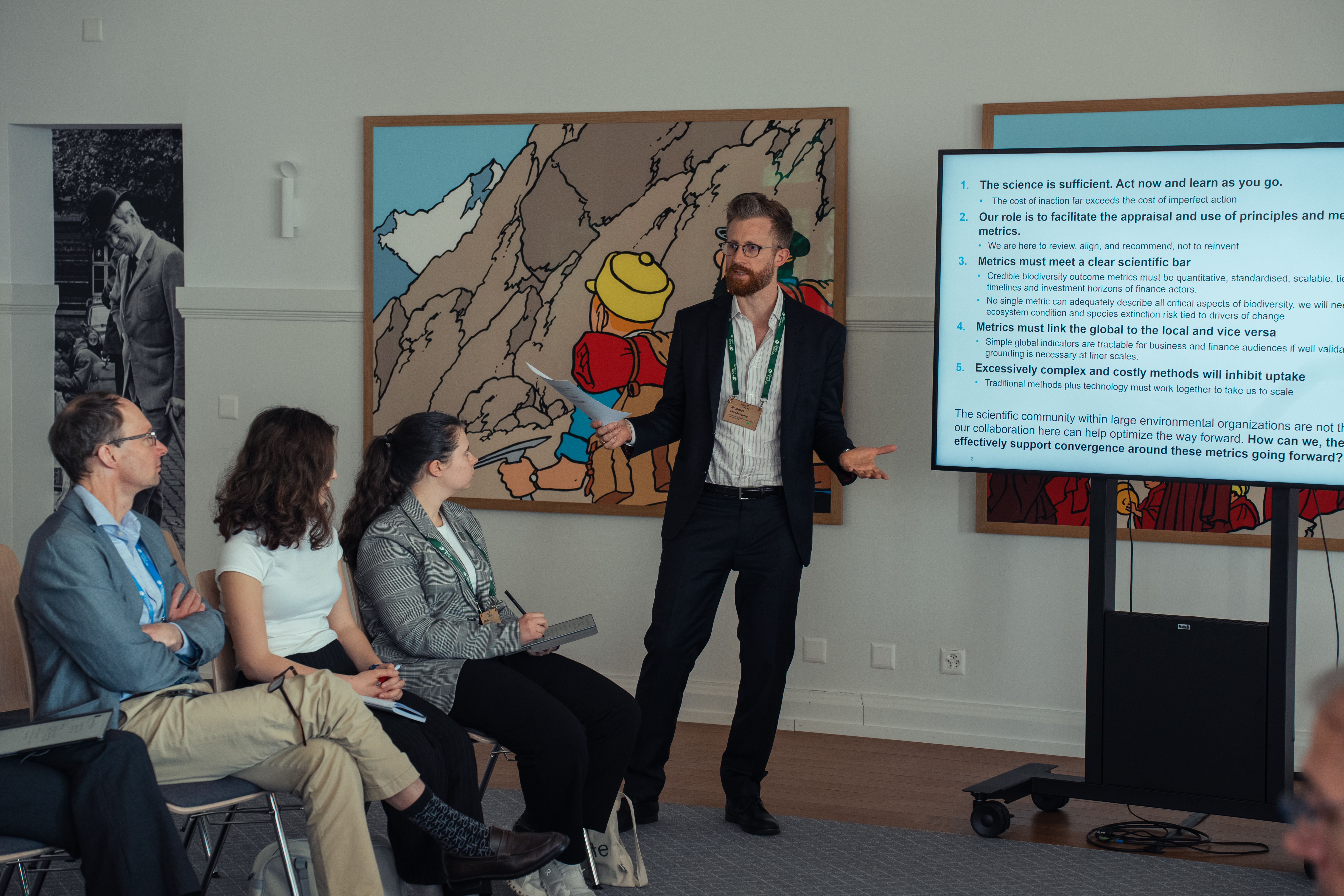
Following this realisation, the experts presented ideas and their current progress, outlined in five concise points.
The current science is already sufficient. As members of the scientific community, the experts urged the notion of “act now, learn as we go” in order to make tangible progress. The research behind metrics is trustworthy, but the issue lies in their number and presentation. The role of a scientist is to facilitate the appraisal and use of principles and metrics. In today’s rapidly evolving technological landscape, there is no need to reinvent the wheel; numerous metrics already exist, and there is no time for new ones to be created. They may not add new value. Even worse, they may simply complicate the already complex nature of metrics. Because the market does not favour constant disruptions, changing metrics continuously would only slow convergence. Metrics must meet a scientific bar. This implies that metrics must be standardised, quantifiable, scalable and sensitive to investor timelines. Metrics should cover a broad scope, and there should not be too many. Another point raised was the notion of location-sensitive metrics, in particular for biodiversity protection. Because location matters, and not all big data is accurate at ecosystem level, metrics must also be spatially explicit; they must describe the location to which they are applicable. Metrics should link both global and local contexts. General global indicators and data may not always reflect local realities. Therefore, it is important to check at local levels, and not just rely on global predictors and indicators, when applying metrics. In response to this point, members of the audience emphasised the significance of new auditing methods and systems to provide accurate data at local levels. A key question raised was: when is data collected at the global scale? In answering this question, as mentioned by the audience, society will be able to “move the cursor” closer between complexity and rigour, theory and practicality. Excessively complex and costly methods and metrics are not the solution. Complex metrics require simple language. It was pointed out that more traditional methods, alongside continuously improving technology, would support scalable metrics. In fact, most companies are already measuring something in nature, perhaps not through highly complex methods, but this should be maintained. Insights from the audience
Following the presentation and Q&A-style part of the panel discussion, individuals in the session were split into two groups and discussed a question raised at the beginning of the session: how can scientists effectively support convergence around metrics going forward?
In order to tackle this question, the audience focused on the real purpose of metrics. Their discussion centred around the idea that metrics are intended for the private sector, and that there is a growing demand for clarity among these stakeholders. Therefore, the importance of consensus and convergence around a small number of proposed metrics was emphasised. Another observation stood out: real success would come in the form of seeing thousands of companies seeking information about nature, and using this information to make real changes to their practices. Therefore, not only for clarity, but also for future success in the private sector, the scientific community must be able to identify the processes of measurement, not only the concepts of metrics.
In response to increasing transparency issues, a point about data monetisation was raised: who actually has ownership over the data?
Closing the discussion, three words beginning with the letter “M” were emphasised by members of the audience: Metrics, Methods and Measurements. It is imperative that companies not only possess information about metrics, but also understand how to measure them. Greater access to knowledge on methods of measurement would reduce various costs for these companies—typically associated with time, research, labour, and opportunity costs linked to not following metrics. The session ended with a statement: the cost of inaction is greater than the cost of action, even if we make mistakes. That said, a learning-focused approach, with data-driven adaptive management, is critical to achieving the panellists’—and hopefully society’s—ultimate goal.