



Ideas from the speakers
The global food system as we know it poses a massive threat to our planet’s future.
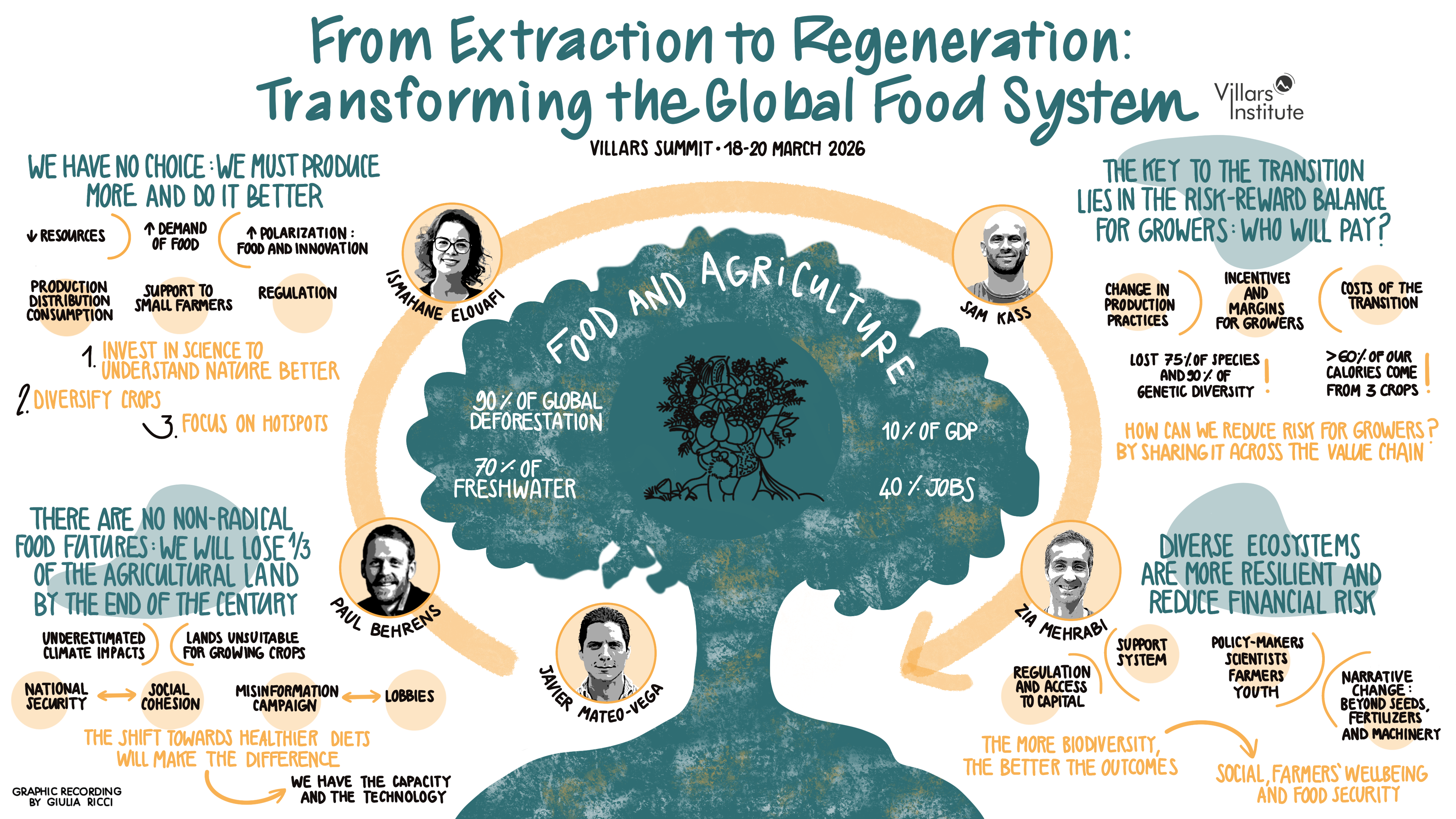
Convened under Chatham House rules, a panel of experts explored the concept of redefining food systems and transforming their extractive nature into a regenerative one that would benefit both people and the planet. Opening with a shared recognition of the urgency of this issue and the need for coordinated action, the discussion began by defining what is meant by food systems. Food systems refer to all actors, processes and infrastructure involved in producing food for people, from identifying land for cultivation to waste management.
Our ability to predict what will happen is impressive, yet we have severely underestimated what those impacts will actually feel like on the ground when they affect us.
Agriculture drives nearly 90% of global deforestation and accounts for over 70% of freshwater use, placing immense pressure on planetary boundaries. Experts argued that turning things around requires redesigning how food is produced. Improving current farming methods means shifting towards regenerative agriculture to make farming more sustainable, resilient, efficient and nutritious.
We have already lost 75% of the species we consume and 90% of the genetic diversity within those species. A collapse similar to the Irish potato famine would have catastrophic consequences not only for agriculture, but also for the global economy. Further loss is something neither people nor the planet can afford. Increasing diversity in agriculture is also key to attracting capital, as diverse systems reduce risk for both investors and farmers.
Despite spending around seven months each year working long hours, often waking as early as 3 a.m. under increasingly volatile climate conditions, many of the people responsible for sustaining this system—the farmers—are among the least rewarded. Many farmers fall within lower- to middle-income brackets and cannot afford the transition required, especially when short-term yields may decline.
The change required must come from the financial system and capital markets. Better production means providing farmers with better technology capable of making agriculture significantly more sustainable. Growers should be rewarded, with investor capital directed towards reducing the risks they take when transitioning to new practices. Farmers also need to be placed at the centre of decision-making and be able to advocate for themselves throughout the process.
What is clear is that the narrative must change. Whatever we are doing right now is clearly not working. Change is urgently needed, and collaboration across all sectors is fundamental if that change is to succeed. If we are going to make the changes needed to sustain both ourselves and the environment, there is no path forward that will not appear radical by today’s standards. We must bring together perspectives from across sectors and direct capital towards supporting farmers, who currently bear many of the costs of transition. Finally, we must invest in the next generation by not only enabling young people to dream, but also by creating the conditions that allow those dreams to flourish.
Insights from the audience
As the session had been delayed, only a limited number of questions could be asked. Most sought clarification on points raised by individual speakers. This led to a concluding discussion in which each speaker summarised their key takeaway, helping to reinforce and connect the main themes of the session and providing greater clarity on the issues discussed.