

Ideas from the speakers
The session explored how nature, finance, culture, and belief interact to shape collective responses to the climate and biodiversity crisis. Participants emphasised that environmental recovery is not only a scientific or technical challenge, but also an economic, cultural, and psychological one.
The discussion opened with the idea that responsibility for environmental action cannot rest solely with producers, farmers, or any single group. Risks and responsibilities must instead be shared across entire value chains. Participants argued that current economic and financial systems fail to properly account for nature and that mental models are just as important as financial mechanisms in shaping responses to environmental risk. How societies think about nature ultimately influences how they invest in, value, and protect it. A central theme was the need to bring nature onto the balance sheet. This involves moving beyond narrow economic indicators and incorporating ecological value and broader human values into decision-making. Participants reflected on how oceans, forests, and other ecosystems remain poorly understood despite their fundamental role in sustaining life. The discussion highlighted how little is still known about the ocean in particular, and how this uncertainty should encourage greater humility and simplicity in approaches to environmental stewardship. The conversation then turned to examples of large-scale regeneration and the optimism they can inspire. Participants noted that nature has a remarkable capacity to recover when given the opportunity. Previous work on global tree restoration and ecosystem recovery has demonstrated significant regenerative potential. At the same time, some restoration efforts have generated criticism where scientific estimates or public narratives were perceived as overly simplistic or overly optimistic. Participants acknowledged that poorly designed interventions, or interventions implemented in the wrong places, can create unintended harm. Effective regeneration therefore requires context-specific approaches grounded in local ecological and social realities.
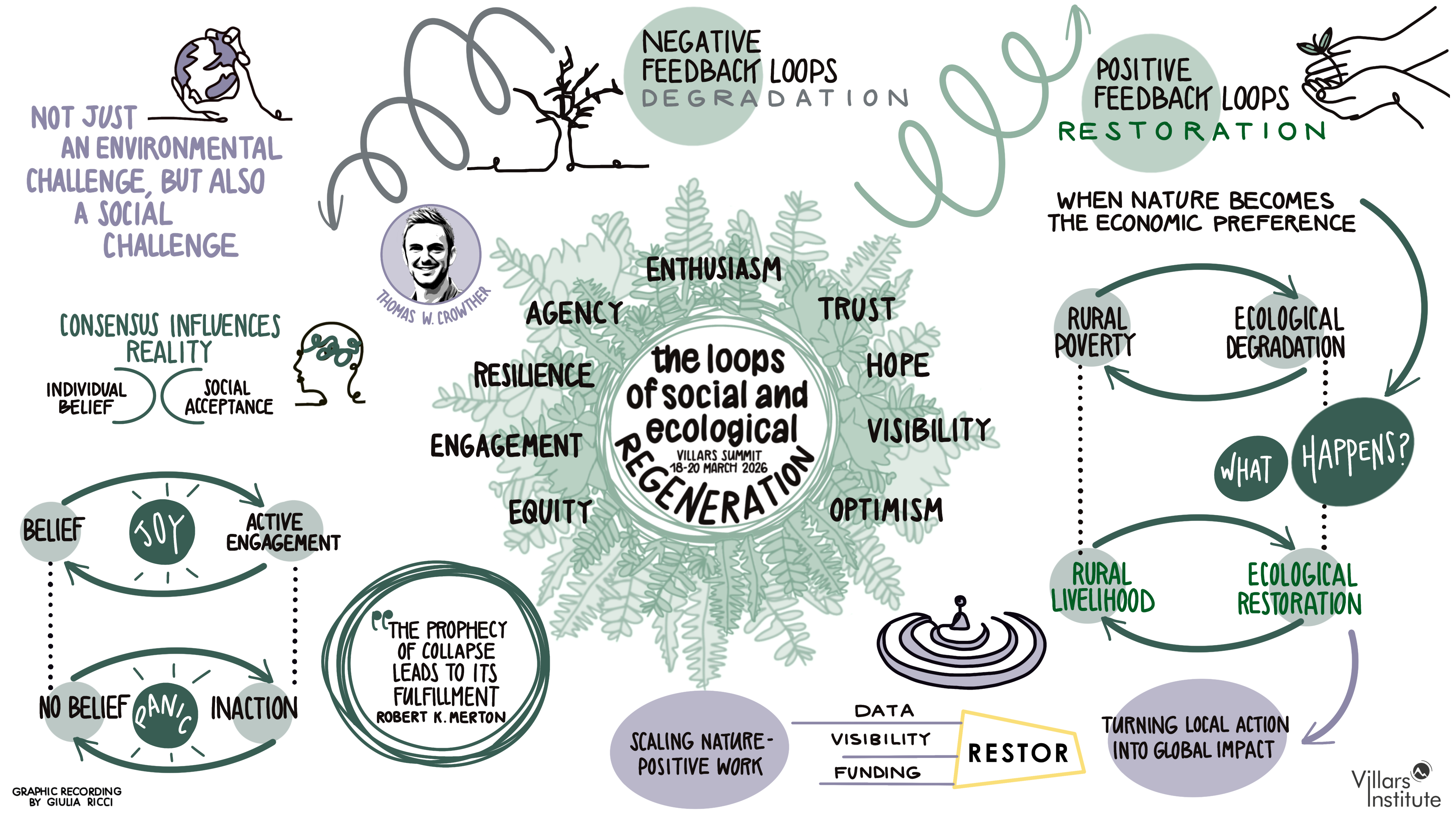
Poverty and rural inequality were identified as major constraints to environmental recovery. Many of the world’s most degraded landscapes are home to communities with limited economic opportunities, where environmental degradation can appear to be the only viable path to short-term survival. However, participants stressed that the same economic forces driving degradation could be redirected towards regeneration if communities are given access to capital, opportunity, and fair participation in value chains. Examples were shared of agricultural regions where regenerative farming practices improved soil health, increased productivity, and strengthened local livelihoods. The session highlighted how embedding nature-positive practices within local economies can generate reinforcing feedback loops. Investment in ecological restoration can strengthen ecosystems while simultaneously supporting more resilient and prosperous communities. Transparency, data, and credible measurement systems were identified as essential to scaling these models, enabling progress to be tracked, trust to be built, and further investment to be mobilised. Another important strand of the discussion focused on how societies define and interpret “reality”. Participants explored how scientific definitions, measurements, and thresholds shape policy and public understanding. Decisions about what qualifies as a tree, a forest, or a unit of biomass influence not only data and reporting, but also real-world outcomes. Although such frameworks are imperfect, they guide decision-making and therefore have material consequences for ecosystems and communities. The conversation also examined the role of belief, emotion, and cultural narratives in driving action. Participants noted that concern about climate change is widespread, yet constant exposure to alarming information can weaken people’s sense of agency and urgency. The discussion argued that belief in the possibility of regeneration is essential. When individuals and communities feel that their actions can make a difference, they are more likely to engage, innovate, and sustain long-term efforts.
Cultural transformation was presented as a necessary complement to technical and financial solutions. Participants argued that societies must shift from viewing nature as a passive backdrop or extractable resource towards recognising it as an active partner and source of opportunity. This shift in perception can create new forms of economic activity, strengthen local identity, and build community pride. Examples such as ecological soundscapes and other visible indicators of recovery were highlighted as powerful ways of making restoration tangible and emotionally resonant. The session concluded that building hope grounded in evidence is not naïve, but strategically necessary. Regeneration at scale will depend on aligning economic systems, cultural narratives, and individual actions in ways that support a more resilient, sustainable, and equitable future.
Insights from the audience
There was no time allocated for audience questions or discussion.