
Ideas From the Speakers
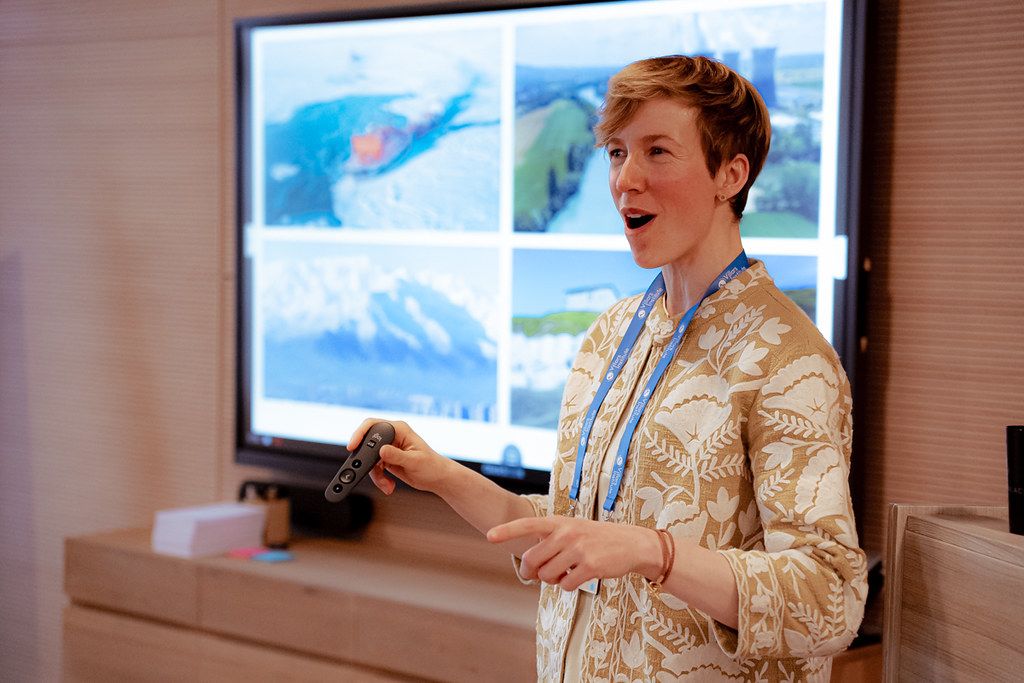
This session focused on one of our biggest challenges in environmental action today: the gap between our ability to measure and understand nature and translating that knowledge into consistent, large-scale action. A shared question emerged: how do we move from data to decisions, and from decisions to meaningful change? The speakers talked about the role of glaciers in sustaining critical infrastructure, freshwater systems, and energy production, and how human systems are intertwined with these natural processes. Yet these systems are mostly absent from existing accountability frameworks. One reason for this is fragmentation and a lack of alignment across frameworks, methodologies, and metrics, making environmental data difficult to compare or operationalize. Complex scientific data can also be inaccessible to decision-makers and the general public, limiting their ability to help make any change or action. Storytelling can be a practical tool for connecting with “a layman’s perspective, looking at everyday users,” so everyone can understand how it affects them on a personal and day-to-day level. One suggestion was “a standard for calculating hidden water when you pour out half a cup of coffee, or you’re pouring out one that’s a liter of coffee, or the 11 liters it took to grow the coffee mix.” Translating metrics into tangible narratives can help make environmental impacts more immediate and actionable. In this sense, storytelling complements standardization: while standards create consistency, storytelling creates connection. Standards and frameworks were offered as potential turning points–by creating a shared language, they could build consistency and trust. This would help scale action across different sectors and geographies, though some areas like ocean systems, have data that is harder to access and measure consistently.
Insights From the Audience
Participants wondered if the current pace of developing standards and frameworks is compatible with the urgency of environmental change. Some expressed concern that waiting for perfect methodologies risks delaying action beyond critical thresholds. Others thought scientific robustness was needed to ensure credibility and avoid fragmentation. This tension revealed a deeper challenge: defining what is “good enough” to act. The pursuit of perfect data and comprehensive frameworks risks slowing progress. The issue of data accessibility also emerged as a significant challenge and barrier, along with the need for shared, open-access data infrastructures and standardized measurement protocols to reduce these barriers and encourage broader participation. There was a shared recognition that many of the necessary components for change are already in place. The challenge is less about inventing new solutions and more about connecting existing ones, and aligning science, standards, finance, and communication into a coherent system. This reframes the notion of a turning point. Rather than a distant future moment, it is something that can be actively shaped in the present through collaboration, simplification, and a willingness to act despite uncertainty.
Next Steps
What was clear from this session is that there wasn’t a lack of knowledge, but a lack of connection and communication between data and decisions, science and people, and tools and action. Despite the limitations we’ve experienced, it also feels like we’re at a point where things could still shift, a turning point in our favor, if we start connecting the pieces. Standards and measurement frameworks can sound technical or even a bit removed from reality, but if reframed, they create a shared language that different groups can all work with (scientists, companies, policymakers). Right now, a lot of these tools are either too fragmented or too hard to access, which limits how useful they actually are, plus a lack of understanding of how this affects everyday lives. This is where storytelling started is both important and necessary. If people can’t understand what the data means in real terms, it’s hard to expect action or engagement. Translating something like water use or ecosystem loss into everyday terms makes it more tangible, and harder to ignore. It helps move things from abstract concepts to something that actually feels relevant. We don’t need new systems, but are challenged with making better use of what already exists. That could mean aligning frameworks more clearly, improving access to data, or just making things easier to understand and apply. There also needs to be more willingness to act without having everything perfectly defined. Waiting for perfect data or perfect standards might hold us back from moving forward or even innovating. Overall, the session suggested that turning points aren’t just something we’re approaching in the future, but something that can be shaped now. A lot will depend on whether we can connect science, communication, and decision-making in a way that actually invites action from everyone.