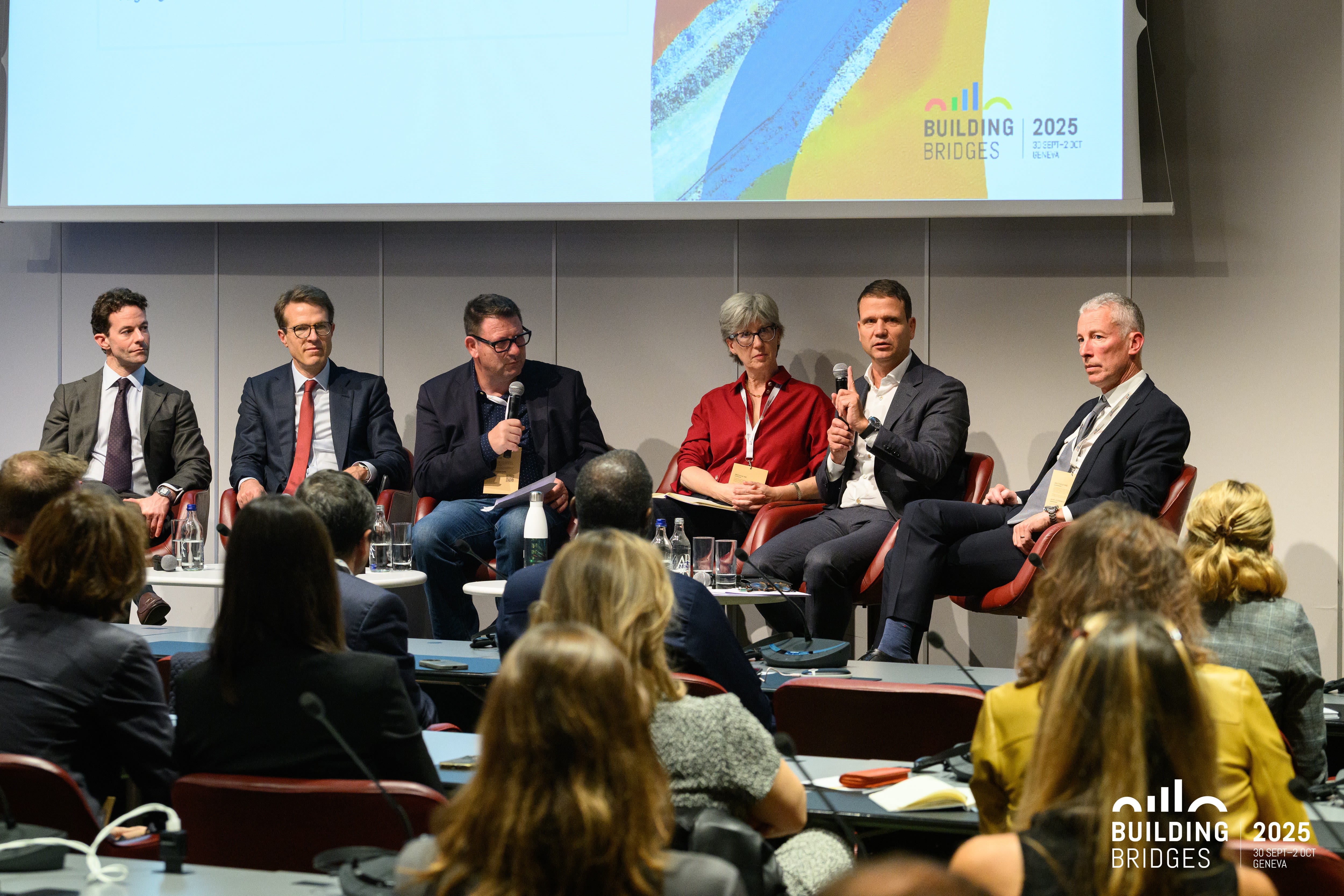

The following is the rapporteur report of an expert discussion held during the Building Bridges 2025 Edition the author is a Villars Fellow.
Building Bridges 2025 / Photographer: Mark Henley
Key Takeaways
The session “Understanding Climate Implications for Assets in Long-Term Portfolios” brought together leading experts from finance, real estate, and sustainability to understand how climate risks are reshaping asset valuations and investment strategies. With the acceleration of climate change, long-term portfolios — particularly in real estate and infrastructure — face both vulnerabilities and opportunities.
A central insight came from one speaker, who explained how sustainability is increasingly aligned with profitability. Real estate now offers clear evidence that environmental performance enhances financial value: green buildings can command a 27% premium over brown assets in equivalent locations. Yet he warned that the stability of these valuations is fragile, as many markets still depend on the availability of insurance to absorb climate shocks. Once this protection weakens, asset values could undergo dramatic correction.
Another speaker provided regulatory and systemic insights. She observed that both high-emitting sectors and climate-solution industries in the UK are under strain due to multiple, overlapping challenges — ranging from rising carbon costs to insufficiently developed policy environments. For example, the closure of refineries and biofuel plants on the UK’s east coast has led to both financial and social disruption. This illustrates how inadequate transition planning can destabilise communities and investor confidence alike.
A more optimistic perspective was offered by another speaker. He focused on how innovation and foresight can convert risk into opportunity. He argued that forward-looking investment strategies — particularly those targeting the energy and industrial transitions — have the potential to drive both climate resilience and economic renewal. He described the transition as not only a necessity but also a chance to reimagine how capital can support societal transformation.
Together, these perspectives reflected a shared understanding that sustainable finance must evolve beyond risk management to become an engine of opportunity and inclusion.
Gaps and Opportunities
Despite growing momentum, several structural and operational gaps continue to disrupt the alignment of finance with sustainability goals.
A major challenge identified during the session was the lack of forward-looking, granular data. While tools and models for assessing climate risk are improving, many asset owners still struggle to translate localised physical and transition risks into portfolio-level strategies. Without high-quality data, investors face uncertainty when managing assets designed to last for decades.
Secondly, policy inconsistency remains a critical barrier. As one of the speakers noted, even companies at the forefront of climate solutions can hesitate when the regulatory framework is fragmented or unpredictable. Such instability weakens long-term investment and slows the scaling of sustainable infrastructure.
Thirdly, market pricing still fails to fully reflect physical climate risks. A speaker’s observations underscored the disconnect between asset valuations and real-world exposure. While green premiums signal progress, the financial system continues to underprice the risks associated with extreme weather, water scarcity, and rising insurance costs. This gap exposes long-term investors to hidden liabilities.
Yet, amid these challenges lie significant opportunities. One speaker highlighted how innovation in transition finance can transform risk management into strategic foresight. Cross-sector collaboration also emerged as a key opportunity: partnerships between governments, investors, and data providers can bridge information gaps and build shared frameworks for transition finance.
For the rising generation of finance professionals, this evolution represents a defining opportunity to redefine the purpose of the sector. Sustainable finance can move from mitigating harm to actively shaping a regenerative economy.
Recommendations
To bridge these gaps and realise the potential of sustainable finance, the following shifts are essential:
- Move beyond box-ticking ESG compliance: Financial institutions must adopt anticipatory, data-driven approaches. Integrating dynamic carbon pricing, physical risk metrics, and climate scenarios into asset management will allow portfolios to adapt to uncertainty rather than react to crises.
- Strengthen coordination across stakeholders: Policymakers, investors, and regulators must harmonise transition finance standards. Establishing shared data platforms and transparent taxonomies would reduce uncertainty and enable comparability across asset classes and regions.
- Redefine value creation for long-term stability: Finance should serve as a lever for resilience — supporting investments that restore ecosystems, strengthen communities, and preserve intergenerational equity. Real estate, infrastructure, and energy projects must be designed not only for profitability but also for sustainability and adaptability over decades.
Overall, this session reflected a growing generational consensus: finance must evolve into a catalyst for long-term well-being. The next phase of sustainable finance will not be measured solely in returns, but in resilience, inclusivity, and impact. To serve both people and planet, the financial sector must embrace innovation, foresight, and collective responsibility as the foundations of a future-ready economy.