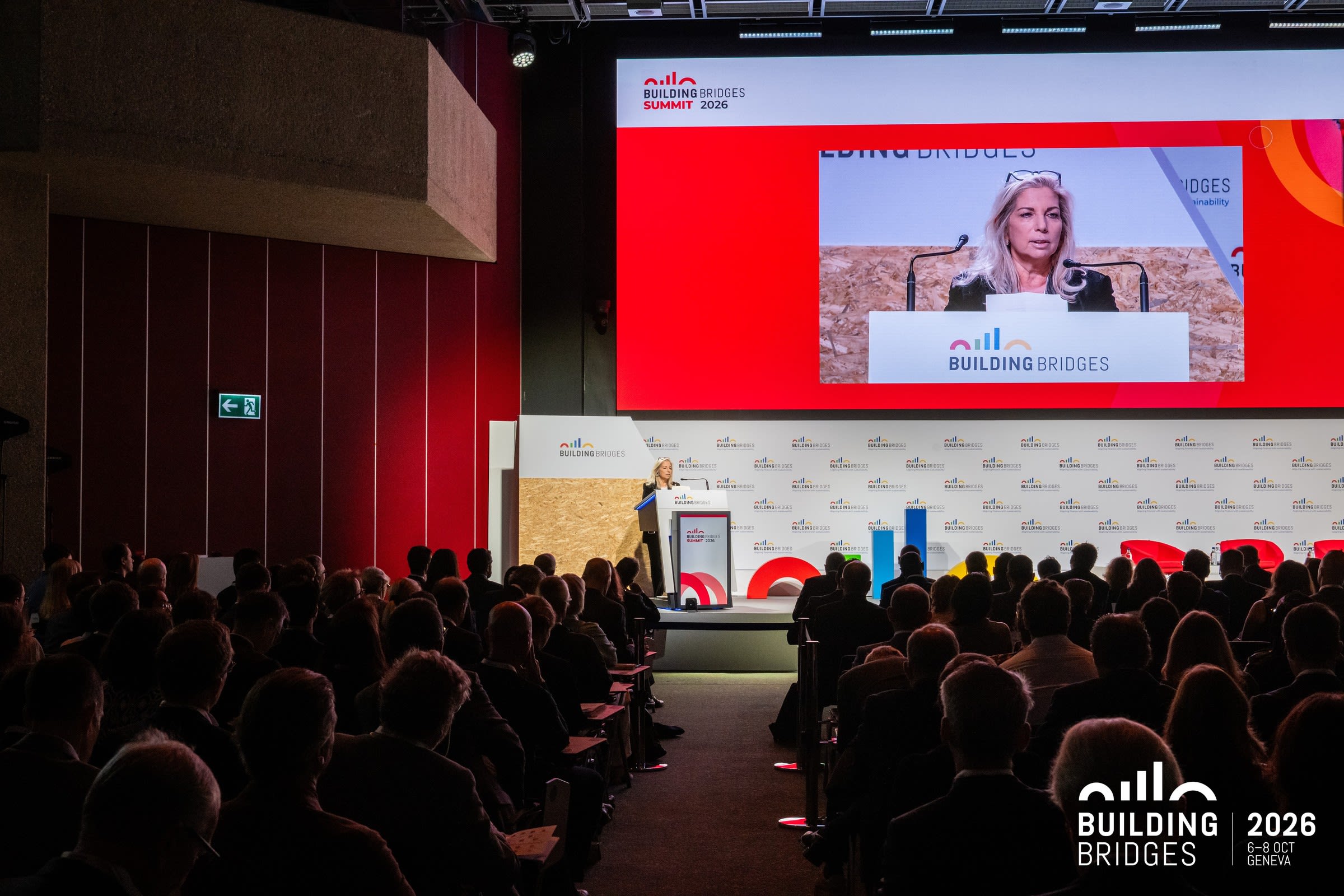

Africa holds some of the world’s most compelling long-term investment opportunities, from critical minerals to green infrastructure, yet it continues to receive only a sliver of global institutional capital. The Building Bridges roundtable brought asset owners, investors, and practitioners together to examine why this gap persists and how it might be closed. The session was organized around three guiding themes:
- Admissibility, or what it would take for institutions to invest more;
- Pathways, or which instruments need to be put in place;
- Next steps, or the concrete actions participants could carry forward.
Rather than following a conventional panel format, the session paired a presentation and two investor case studies with an open discussion, anchored by a single question to participants: which condition remains binding in your institution, and what changed when you solved it in another growth market? The answers revealed that the obstacles are rarely the opportunities themselves, but rather the gatekeepers, mandates, and perceptions that stand between asset owners and the continent.
Presentations and Concrete Examples
The session opened with a presentation from the Africa Investor (Ai) Group on scalability in Africa. Its central argument was that African infrastructure must be approached as an institutional asset class rather than financed transaction by transaction. Allocators need institutionalized pathways into the market, with origination happening at the level of the asset class and the private sector both leading and learning along the way. The presentation stressed that activity is already well underway: $5.1 billion has been invested across 530 deals, with 81 successful exits. Africa also holds what was described as an unfair advantage, namely its mineral wealth and its potential as a green asset class, linked to a “5 percent agenda” that would see a set share of allocations directed toward the continent.
Scale, the presentation argued, depends on repeat allocation. Most models are built on public–private partnerships underpinned by productive assets, and asset owners need a hand in designing investment vehicles if they are to generate meaningful exposure. A range of routes are already in use: direct strategic assets, such as the Qatar Investment Authority’s involvement in the new Kigali airport; direct investment from managers such as BlackRock; infrastructure funds backed by global pension investors and A.P. Moller, by Dutch and Danish pension funds through ILX, and by Mubadala through Masdar Africa and the Africa Green Investment Initiative; and African institutions such as South Africa’s PIC and GEPF, which invest through the Africa Finance Corporation and support Harith.
The first concrete example came from an investor that splits its allocation evenly between global and African markets. With $3 billion invested on the continent and a further $5 to 6 billion deployed through smaller corporate funds and other vehicles, it demonstrated that the scale is already there. Its portfolio spans hybrid capital, blended-risk structures, and private equity, and its fund-of-funds approach has so far outpaced inflation despite currency fluctuations. Crucially, the investor attributed its success to visibility: board members were taken to Ghana, Benin, Uganda, and elsewhere to see projects first-hand, and communication was maintained at every level of the institution. It also cautioned against selecting individual projects across the continent, as one might in Europe, and recommended working through an experienced asset manager instead. A final lesson concerned presentation: portfolios intended for global investors should be reported in standard international currencies rather than local ones in order to remain legible to their audience.
The second example was a blended finance vehicle, Alliance Credit Emerging Markets (ACE), which has invested $2 billion in emerging markets, raised $4 billion, and completed nine exits. Its success was attributed to a deep understanding of local context, which allows it to navigate risk rather than avoid it. First-loss capital has proven effective in attracting investors, although full credit assessment remains essential, and the blended structure fundamentally changes the risk–return dynamics for participants. The vehicle invests alongside multilateral development banks and development finance institutions, with close attention to governance. Its central message resonated throughout the room: there is always risk, but much of the risk associated with Africa is perceived rather than real.
General Notes from the Discussion
The open discussion made clear that the binding constraint for most institutions is not a lack of opportunity, but the layers of decision-making that sit between asset owners and the continent. Gatekeepers, including large insurers and investment consultants, play a decisive role in what is even considered. Under discretionary mandates, investment choices rest with the manager, who tends to look bottom-up for attractive diversification. Participants noted that consultants are often more open than assumed, yet remain largely conservative in practice.
Sustainability and impact emerged as one of the most promising bridges. Emerging economies sit at the intersection of sustainability goals and future growth, and investors seeking stability and long-term returns within strict budgets may find what they are looking for there, despite a persistent tension between local and global priorities. Impact budgets offer a natural entry point, since the greatest impact per dollar is often achieved in Africa, and the tokenization of impact in markets abroad was raised as a possible tool. From a nature perspective, while roughly 70% of natural-resource exposure sits in developed economies, global supply chains, such as those for carbon-negative coffee, create indirect impact and offtake demand in emerging markets. Even so, concern still outweighs enthusiasm for many investors.
Perhaps the most striking insight concerned the role of psychology and reputation. One participant observed that they had never received a firm “no” to Africa; instead, the continent is quietly filtered out much earlier in the process. Fiduciary teams and pension fund regulations prevent managers from investing freely, regional restrictions become prerequisites, and Africa is usually the first region to be sacrificed. As a result, the continent is frequently discussed but rarely invested in. Decisions are shaped by press coverage, reputational risk, and the backgrounds of board members, many of whom built their careers in policy. On a more positive note, momentum toward Africa is building, and the impact narrative has resonated with boards. Understanding why early investors chose to commit was seen as key to knowing how to pitch to others.
Participants also highlighted the importance of safety in numbers. Pension fund representation was described as essential, captured in the remark that it is “better to be wrong together than right alone.” Investors need to syndicate as a group and approach their boards with aligned action. In one case, boards had to be taken to Africa before they would invest there, as seeing a real project remains a major hurdle. The critical role of the asset manager was also emphasized, along with a global-first approach: where the best opportunities lie in Africa, exposure can be scaled progressively, from 5% to 10% and eventually 30%.
The discussion closed with reflections on political risk, which participants largely attributed to prejudice rather than reality, and which can be addressed through webinars and convenings that bring people together. First-loss capital was seen as a sound starting point for de-risking, and there was broad agreement that investors should be brought together to fund decarbonization at scale.
Action Items
Several concrete actions emerged from the roundtable, centered on building a coalition of asset owners who move together, supported by proven success stories and de-risked structures.
The first is to engage the gatekeepers early. Investment consultants should not be underestimated; involving them from the outset and framing African exposure in terms of the added value it brings to the overall portfolio rather than as a standalone bet can help shift conservative defaults.
The second is to build a coalition of first movers. Participants proposed gathering success stories, positive experiences, and early investors into a coalition supported by a dedicated risk budget. Bringing well-known institutions on board would lend their names and reputational cover to others, while syndicating pension funds would allow them to approach their boards together with aligned action.
The third is to address reputation and risk directly. Pension funds need support in setting reputational concerns aside, accepting that some risk-taking is necessary while keeping it minimized. Entering new regions alongside partners with a supranational presence, as has been done in Asia, can help share reputational exposure. First-loss capital and blended structures should serve as the starting point for de-risking, while webinars and convenings can help dismantle prejudice around political risk.
The fourth is to create visibility and find new avenues for investment. Board visits to projects on the ground should be organized so that decision-makers can see assets first-hand. Institutions should explore new allocation pathways, such as a global-first approach that progressively scales African exposure, and present portfolios in standard global currencies to remain legible to international investors. Investors should also be brought together to fund decarbonization at scale.
Ultimately, the roundtable reinforced that the bridge between asset owners and Africa will not be built by any single institution acting alone. The capital, the track record, and the opportunities already exist; what remains is the collective will to act on them together.