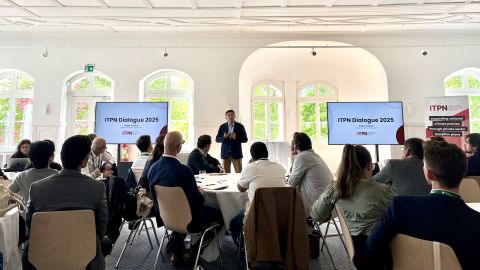



The following is the rapporteur report of an expert discussion held during the Building Bridges 2025 Edition , the author is a Villars Fellow.
Building Bridges 2025 / Photographer: Antoine Tardy
Summary:
This session showcased the first fixed income index to cover the whole fossil fuel chain, providing objective criteria needed to drive down real-world emissions through changing flows of capital. It informed participants about the index’s content and focused on the unique building process, held between academia, the index provider, and asset owners. The index mentioned and covered is from a research paper titled: Quigley, Ellen. Evidence-based Climate Impact: A financial product framework.
Overview:
The panel explored how large investors — such as pension funds and insurance companies — can make a real difference in fighting climate change through their investment choices. Currently, most ESG (responsible investment) efforts focus on the stock market, where investors buy or avoid shares in companies that are deemed not to advance the survival of life considering the climate crisis. However, about 90% of the new money flowing into fossil fuel projects comes from debt, not stocks. Debt means companies raise money by borrowing — for example, by issuing bonds, which are like IOUs. Because most fossil fuel funding comes from bonds, the panel argued that focusing only on stocks is not enough to influence company behaviour or reduce real-world emissions. Instead, investors can have more impact by targeting the fixed income market, which is the area of investing focused on bonds and other debt instruments.
The opportunity:
The panel also discussed the primary market (where new bonds are issued and companies directly raise money) and the secondary market (where existing bonds are traded between investors). “Tapping into” both markets is crucial to encourage the green transition by influencing how easily and cheaply fossil fuel companies can borrow.
A solution:
Cambridge University, with Bloomberg’s help, created a new Fossil Fuel Phase-Out Bond Index, which is expected to launch at the end of this year. For the curious: the Bloomberg Aggregate Bond Index, or “Agg,” is the parent index. An index is like a recipe book — it lists which bonds (or stocks) should be included based on specific rules, such as excluding companies that are expanding fossil fuels. In the financial “next step,” funds then adopt (follow or track) the “recipe” of the index to build their portfolios. The silver lining is that anyone interested in the growth of this index can invest either personally or through various entities in these funds. This is particularly significant as the “Agg” is a critical benchmark for the U.S. investment-grade bond market, reflecting over $50 trillion in fixed-income securities. The general message was that by excluding fossil fuel bonds and rewarding cleaner investments, this new index aims to make it more expensive for fossil fuel companies to borrow money and encourage a faster transition to renewable energy.
Thoughts:
This initiative has been over ten years in the making. While it depicts a financial instrument that is purely evidence-based due to its academic origins, it can also be trusted thanks to its sponsor, Bloomberg, which will help ensure a successful launch. This effort can gain considerable traction and encourages anyone who wants to make an impact in the sustainable development space to invest — even personally — in the funds that will track it. Released November 2025.
Glossary:
- ESG investment: An investing principle that prioritizes environmental issues, social issues, and corporate governance.
- Bond: A type of investment where an investor lends money to a company or government for a set time in exchange for regular interest payments and repayment of the full amount later. When a company issues a bond, it’s basically borrowing money from investors — but instead of going to a bank, it’s borrowing directly from the public or institutions.