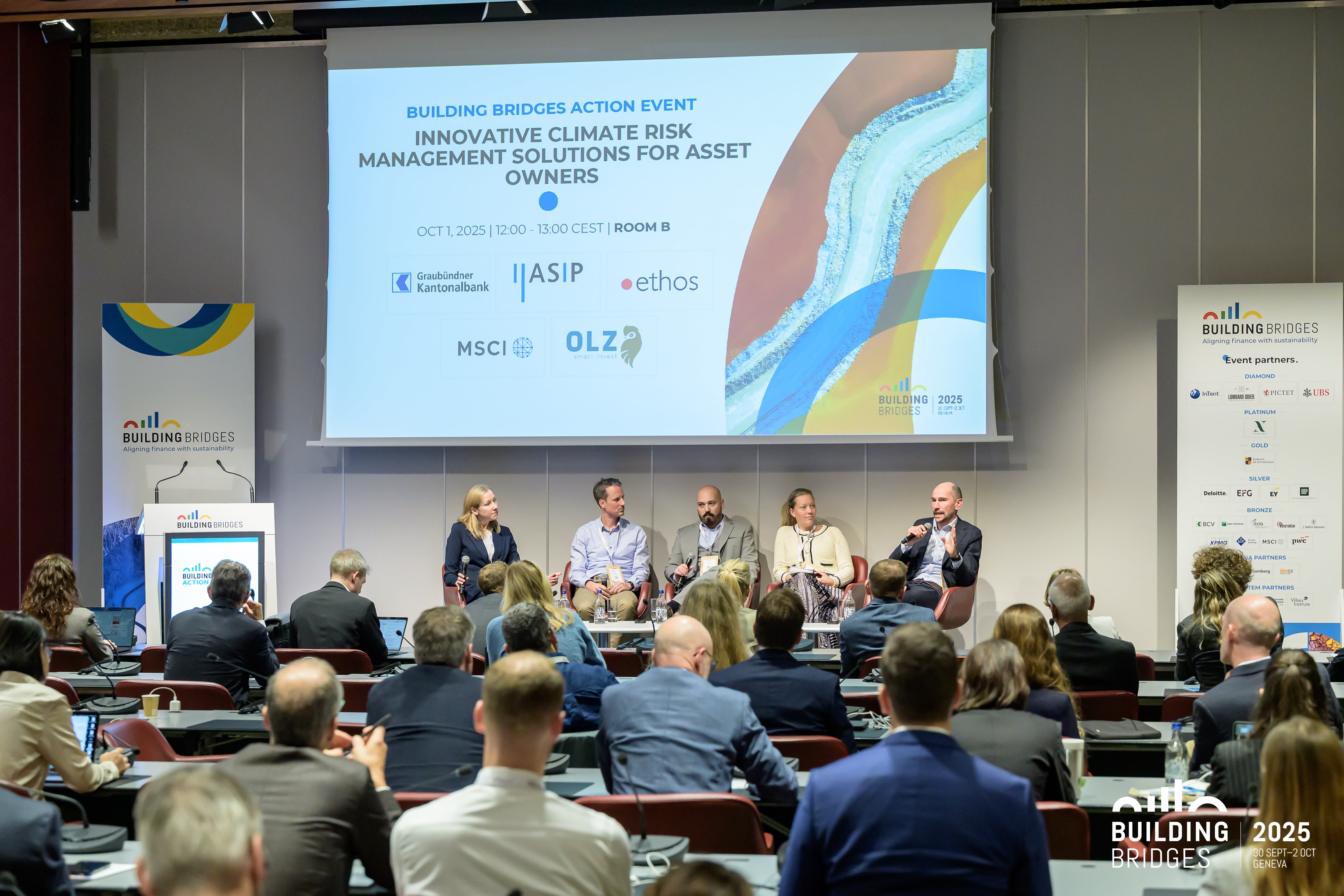

The following is the rapporteur report of an expert discussion held during the Building Bridges 2025 Edition, the author is a Villars Fellow.
Building Bridges 2025 / Photographer: Francois Wavre
Key Takeaways:
The session “Innovation in Climate Risk Management Solutions for Asset Owners” hosted a discussion on how climate-related risks are redefining long-term financial value. The panel explored how asset owners, particularly small and mid-sized pension funds in Switzerland, can navigate transition, physical, and nature-related risks while maintaining performance and fiduciary duty.
The speakers underscored a generational shift: finance must evolve from reactive risk management to proactive systemic resilience. The moderator framed the issue by noting that over half of Swiss pension assets are managed by smaller funds that lack in-house expertise, making collaboration and innovation crucial.
One speaker explained that his pension fund, managing CHF 400 million, relies on external managers to integrate ESG and climate risks. He emphasized that climate risk is not an abstract concern but a financially material factor, requiring each asset manager to embed ESG processes into their investment approach.
Another speaker discussed the feasibility of portfolio decarbonization. By excluding only a few of the largest emitters, a fund can achieve up to a 30–50% reduction in carbon intensity without sacrificing returns. However, he cautioned that the real-world impact of such portfolio adjustments remains uncertain — raising the question of whether financial decarbonization truly equates to genuine emissions reductions.
A different contributor expanded the discussion, stressing that climate risk goes far beyond carbon metrics. She highlighted the growing importance of physical and nature-related risks — from biodiversity loss to supply chain disruptions — and emphasized the need for deeper analysis and improved data quality. While transition data has matured, nature-related data remains several years behind.
Another speaker addressed stewardship as a lever for systemic change, observing that engagement between investors and companies is becoming increasingly two-way. Yet, diverging shareholder priorities — short-term versus long-term interests — continue to hinder progress.
Finally, the discussion touched on the role of artificial intelligence (AI). One speaker noted that AI can accelerate data collection and verification, reducing the time required to assess risks. However, she cautioned that AI’s significant energy footprint demands responsible deployment to avoid undermining environmental goals.
Gaps and Opportunities:
The session highlighted several structural and practical gaps. A key challenge lies in the capacity deficit among small and mid-sized pension funds. Two speakers observed, limited in-house expertise forces smaller asset owners to depend heavily on consultants and external managers — many of whom also lack sustainability literacy. This creates a systemic dependency that slows progress.
Another pressing issue is data quality and reliability. Participants raised concerns about corporate misreporting and greenwashing, citing emissions scandals that have eroded confidence in sustainability claims. There should be limited assurance and external auditing of sustainability reports, which is mandatory in the EU but still voluntary in Switzerland. One speaker acknowledged that although the volume of available data is growing, its financial materiality and consistency remain uneven. This lack of trustworthy information hinders both reporting and risk management, especially for funds seeking to quantify exposure to physical climate events or nature degradation.
At the same time, the dialogue revealed meaningful opportunities. AI and digitalization can play a transformative role in improving data granularity, automating reporting, and identifying risks in near real time. The trend toward two-way engagement between investors and companies also presents an opportunity to align expectations and foster collaboration.
Moreover, expanding the focus beyond carbon to conduct nature-based risk assessment represents the next horizon for sustainable finance, aligning with global biodiversity frameworks.
Recommendations:
- Capacity building must become a collective priority: Regulators, financial institutions, and educational bodies should collaborate to offer practical training programs and shared analytical tools for small and mid-sized asset owners.
- Transparency and accountability must be institutionalized: Universal sustainability reporting standards — backed by independent verification and limited assurance — should become the norm, ensuring that all asset owners can rely on consistent, comparable information.
- Finance must move from compliance-based ESG approaches to impact-oriented engagement: As one speaker argued, exclusion is not the answer. Investors should accompany companies along their transition pathways rather than divest outright.
- Nature-based risk management must be integrated into investment practice: One speaker noted that climate and nature are inseparable. Building data infrastructure and analytical capacity around biodiversity, land use, and water stress will be key to ensuring that portfolios support planetary resilience as well as financial returns.
The financial system must become transparent, inclusive, and regenerative — one that aligns profitability with planetary boundaries and measures success through resilience and shared prosperity. Through collaboration, innovation, and education, finance can evolve from a risk management tool into a catalyst for long-term value creation.