

Ideas from the speakers
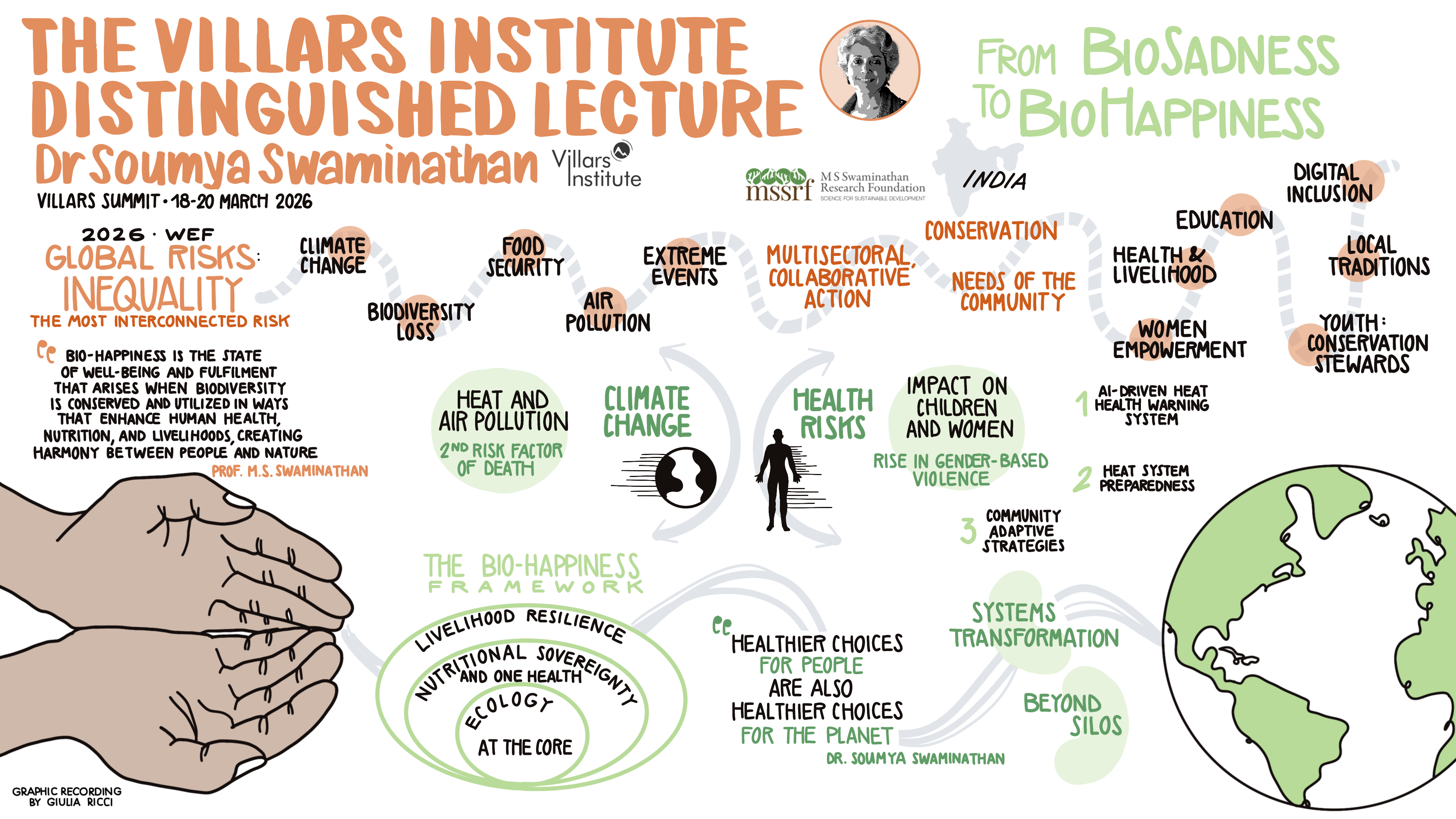
The 7th Distinguished Villars Lecture explored the concept of “biohappiness” as a framework for rethinking development by placing ecological well-being alongside human health, nutrition, livelihoods, and social equity. Rather than treating environmental and social challenges as separate issues, the lecture argued for a systems approach that recognizes their deep interdependence. Current measures of progress, including GDP and measures of national happiness, often fail to adequately account for biodiversity, ecosystems, and the natural resources on which human well-being ultimately depends.
The presenter situated this argument within a landscape of interconnected global risks. Climate change cannot be considered in isolation from biodiversity loss and pollution, while inequality acts as an underlying factor that determines who is most exposed and least able to adapt. Food systems provided a clear example. Although thousands of plant species have historically been used as food, global diets now depend heavily on only a few crops. Intensive agricultural practices have contributed to declining agrobiodiversity, soil degradation, pollinator loss, and increasingly vulnerable food systems. At the same time, billions of people remain unable to afford a healthy diet despite sufficient global food production.
Examples from community-based initiatives demonstrated what systems thinking can look like in practice. Mangrove restoration illustrated how conserving ecosystems can simultaneously strengthen coastal resilience, protect biodiversity, create livelihoods, and contribute to carbon storage. Work with indigenous and farming communities showed the value of protecting traditional crops, community seed banks, sacred groves, and locally held ecological knowledge. Importantly, conservation was presented as unlikely to succeed when separated from people's economic realities: communities must be able to benefit from protecting the ecosystems around them.
Technology was similarly framed as an enabling tool rather than an end in itself. Participatory digital platforms, biotechnology, artificial intelligence, and environmental monitoring can support communities when combined with local knowledge and genuine participation. Across these examples, particular attention was given to women, young people, and marginalized communities, whose knowledge and labor are often essential to food systems and conservation but remain insufficiently recognized.
Ultimately, biohappiness was proposed as a possible foundation for thinking beyond the Sustainable Development Goals: a model in which ecology sits at the core of development and healthier choices for people become healthier choices for the planet.
Insights from the audience
The lecture reinforced the importance of moving beyond fragmented responses to environmental, health, and development challenges. A central insight was that many of the problems society attempts to solve individually are, ultimately, different expressions of the same interconnected system. Climate change affects food security, health, migration, livelihoods, gender inequality, and biodiversity, meaning that progress in one area cannot be sustained if interventions create new vulnerabilities elsewhere.
The examples presented also highlighted the importance of local agency in systems transformation. Communities were not portrayed simply as beneficiaries of scientific or conservation initiatives, but as holders of knowledge and active participants in designing solutions. Indigenous communities protecting biodiversity, women conserving traditional crop varieties, and fishing communities helping to shape digital tools all demonstrated that successful interventions are stronger when they combine scientific expertise with lived experience. This challenged conventional models in which solutions are developed centrally and later introduced to communities.
Another important takeaway concerned the relationship between environmental protection and equity. Conservation cannot simply require vulnerable populations to sacrifice access to resources for the sake of nature. Sustainable solutions must create viable livelihoods, expand access to knowledge and finance, and recognize groups whose contributions have historically been overlooked. The discussion of women farmers was particularly illustrative: despite making up a significant proportion of the agricultural workforce, women often lack formal land ownership, which can restrict their access to credit, resources, and institutional support.
The health dimension of climate change further expanded the audience's understanding of environmental action. Heat, air pollution, extreme weather, malnutrition, infectious disease, mental health, and gender-based violence demonstrate that climate change is not only a future environmental threat but a present human health challenge. Adaptation therefore needs to account for differences in exposure and capacity, particularly among vulnerable groups.
Although time for audience questions was limited, the final exchange distilled perhaps the most significant barrier identified throughout the lecture: silos. The challenge is not necessarily a shortage of knowledge, technology, or individual solutions, but the difficulty of connecting institutions, sectors, disciplines, and communities. The session therefore left a clear message: meaningful transformation requires moving from isolated interventions and indicators toward integrated systems that value ecology, human well-being, equity, traditional knowledge, and technological innovation together.