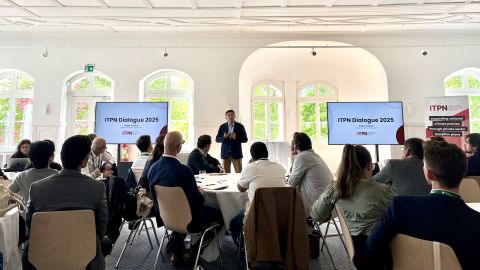



The following is the rapporteur report of an expert discussion held during the Building Bridges 2025 Edition the author is a Villars Fellow.
Building Bridges 2025 / Photographer: Mark Henley
Summary
This session explored where we stand on net zero finance and where we need to go. Drawing on CPI’s Net Zero Finance Tracker and insights from the Global Innovation Lab for Climate Finance, it examined both the integrity of climate commitments and observed progress and impacts in the real economy. The discussion also assessed current drivers and gaps in action and how to address them, while focusing on the role of financial innovation in mobilizing capital—particularly from institutional investors—toward real-economy solutions.
Overview
Financial institutions’ portfolios in the power sector remain dominated by expansionist fossil fuels (69%), leading to the continued deployment of new fossil fuel capacity, despite the IEA’s Net Zero Scenario indicating that none should be built.
There is a large investment gap in clean energy, particularly in developing countries, where direct investment in new fossil capacity still exceeds that in clean energy. Asset managers and institutional investors in developed countries remain critical to scaling up engagement with investee companies, helping them shift away from fossil fuels and enabling clean energy deployment.
Key Takeaways
The speakers highlighted that, despite some progress in corporate engagement, credible action remains limited, with financial institutions still signalling support for fossil fuel expansion. Innovative investment structures could help mitigate the perceived risks that currently deter capital flows—especially toward developing countries, where legal and financial frameworks often prevent investor participation.
While the need for adaptation is widely recognized, it remains chronically underfunded, as few are willing to bear the associated costs. Ultimately, financial innovation is essential to unlocking the capital needed to shift from fossil fuels to clean energy and close the global investment gap.
Addressing Scope 1 and 2 emissions is now well understood, but achieving real impact requires engaging with large institutional players—particularly pension funds—which can lead by example through their long-term capital and influence. Scaling climate solutions is critical, but scale must be pursued thoughtfully: it is not about replicating models blindly, but about expanding what works in each local context. Practical case studies, rather than “copy-paste” approaches, are needed to guide this process.
Insurance also remains an underused instrument for de-risking, particularly through mechanisms such as parametric insurance, which can enhance the bankability of renewable energy projects like wind and solar. As insurers increasingly act as shock absorbers across the value chain, a key guiding question arises: How can insurance protect both farmers and global supply chains to create win-win outcomes?
It was concluded that stakeholders should:
- Use insurance more effectively, as it can de-risk projects and help close the climate finance gap.
- Join the dialogue to connect new problems with new solutions.
- Recognize that money has impact—and that ultimately, we must ask ourselves where that money is going.
Recommendations
Insurance plays a key role in the development of nature-based solutions, especially in the Global South. Stakeholders should look forward to the potential that insurance and pension funds can unlock.
It is also recommended to consult:
Both tools offer valuable services for scaling meaningful and impactful projects toward achieving net zero goals.